
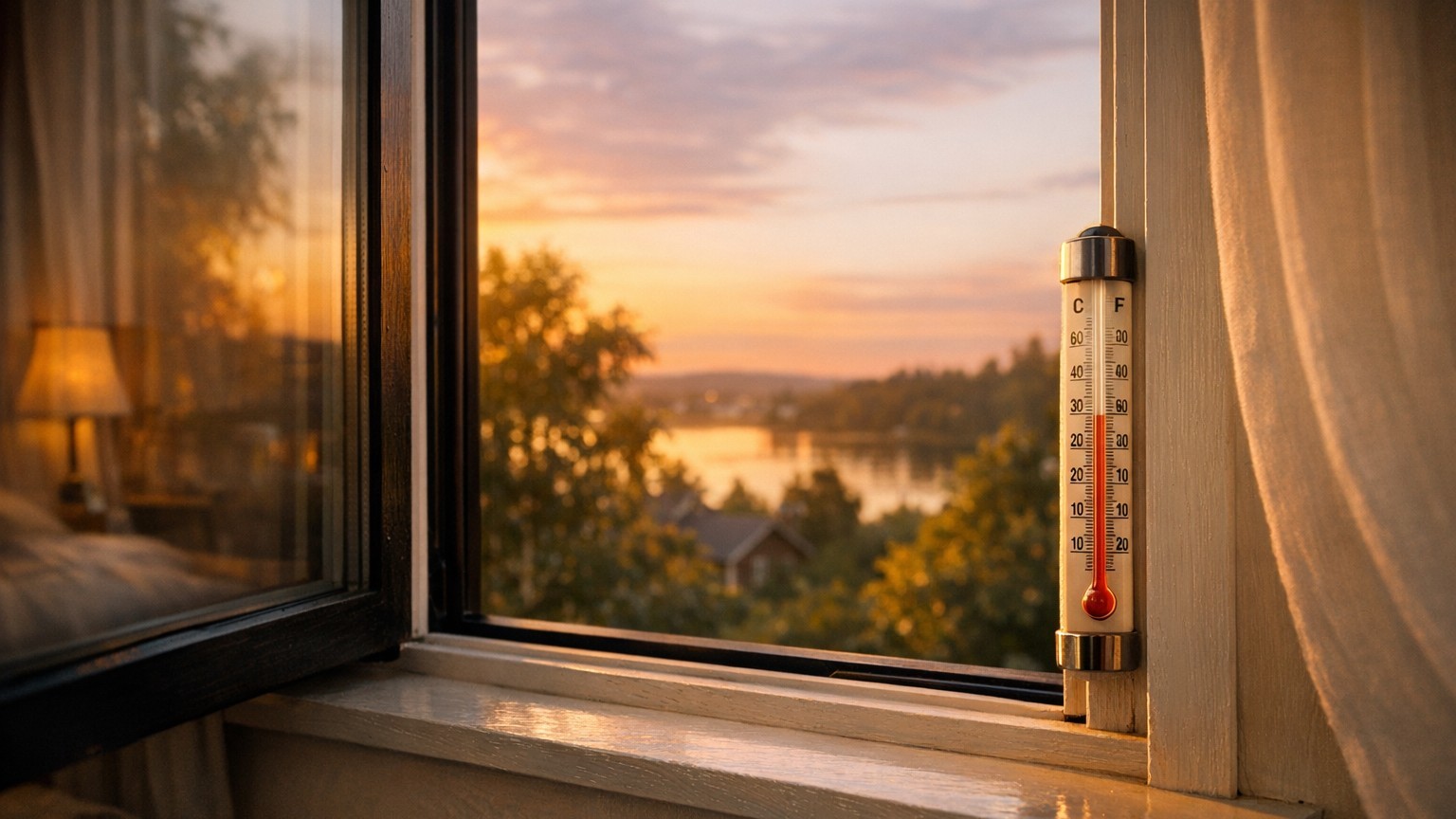
The heatwave hit on a Tuesday. By Thursday night, the bedroom was still radiating heat at 11 p.m., walls warm to the touch, the air dense and stale, the ceiling fan stirring nothing useful. Like most people without central AC, the reflex was automatic: throw the windows open, let the night air in, hope for the best. That logic seems airtight. It isn’t.
A builder friend, the kind who notices things civilians miss, walked through the house one afternoon and said something that reframed Everything. “You’re ventilating at exactly the wrong time.” He wasn’t talking about the middle of the day, everyone knows to keep the blinds down then. He was talking about the nights. The very ritual that felt like relief was, in most cases, pumping warm air into a home that had only just started cooling down.
Key takeaways
- Your walls are heat storage units still radiating warmth well into the night—opening windows too early traps that heat inside
- Opening windows when outdoor temps are still higher than indoor temps actively works against cooling your home
- Scientists call the correct technique ‘night flushing’—but timing, humidity levels, and cross-ventilation direction are everything
The mistake almost everyone makes
The instinct to open windows at night during a heatwave is understandable, but it rests on a flawed assumption: that nighttime air is always cooler than the air inside your home. During a serious, multi-day heat event, that’s often not true, at least not until much later than you think.
The most common mistake, according to housebuilder John Small, is opening the window every time the temperature rises inside. “If it’s cooler inside than outside,” he notes, “you should keep your windows closed.” Opening them when it’s hotter outside simply draws warm air in, making the house harder to cool down.
Many people believe that opening windows during heatwaves always brings relief. In reality, when the temperature outside is higher than inside, opening windows can worsen the situation by bringing hot air into the interior. In such conditions, keeping windows closed and using curtains or blinds to limit solar heating is the smarter move.
The builder’s actual advice: check a thermometer before you touch a window handle. One practical approach is to use a digital thermometer or download an app to compare indoor and outdoor temperatures. If the weather outside is hotter, close your windows to trap the cooler air in. Only open them if the inside of your house is hotter, which usually happens in early morning or late evening.
What your walls are actually doing to you at night
Here’s the part that genuinely keeps you awake once you understand it. Your walls and floors are not passive bystanders in this drama, they are slow-release heat storage units, and during a heatwave, they work against you.
By 2 or 3 p.m., interior walls might still feel relatively cool. But by evening, the heat from the day has penetrated deep into the wall material, and as the walls cool during the night, that captured heat is released back into your living space. This is thermal mass doing exactly what it was designed to do. In winter, you’d love it. In August, it’s architectural betrayal.
Inappropriate thermal mass can radiate heat back to you all night as you try to sleep during a summer heatwave. Brick and concrete are especially guilty of this, thermal lag is the rate at which heat is absorbed and released by a material, and materials like brick and concrete absorb and release heat slowly. That sluggishness means the heat your walls soaked up at 2 p.m. is still seeping out at midnight. Opening windows earlier in the evening, before outdoor temperatures have genuinely dropped, pumps more warm air onto already-warm surfaces and prolongs the cycle.
Research published in Energy found that increasing a building’s thermal mass reduced average indoor temperature during a heatwave by 2.8°C, with the maximum reduction at the hottest part of the day reaching 3.4°C, but only when the ventilation strategy was correctly timed to work with that mass, not against it.
The “night flush”, and how to actually do it right
Building scientists have a name for the correct technique: night flushing. Night flushing is a passive or semi-passive cooling strategy that requires increased air movement at night to cool the structural elements of a building. The key word is “structural.” You’re not just cooling the air in the room, you’re trying to cool the walls and floors themselves so they act as a heat absorber the next day rather than a radiator.
To execute night flushing properly, you keep the building envelope closed during the day. The building’s thermal mass absorbs heat gains from occupants, equipment, solar radiation, and conduction through walls and ceilings. At night, when outside air is genuinely cooler, the envelope is opened, allowing cooler air to pass through so stored heat can be dissipated by convection.
Timing is the variable that changes Everything. For optimal performance, the nighttime outdoor air temperature should fall well below the daytime comfort zone limit of 22°C (72°F), and should have low absolute humidity. That threshold matters, opening the windows at 9 p.m. when it’s still 76°F outside defeats the entire purpose.
Direction matters just as much as timing. Once temperatures genuinely drop in the evening, opening windows on opposite sides of the house creates cross-ventilation that draws in cooler air. Since hot air rises, opening windows upstairs and using a fan can quickly push that hot air out of the house. The fan positioning is counterintuitive: using negative pressure ventilation, a technique employed by firefighters to clear smoke, means positioning your fan facing an open window rather than pointing into the room. It draws cool air in while pushing warm air out.
Night flushing is most effective in climates with a large diurnal swing, a large difference between the daily maximum and minimum outdoor temperature. In the desert Southwest or in mountain towns, this is a powerful tool. In Houston or Miami at the height of summer, less so: in hot or humid conditions, open windows can increase indoor humidity, making the AC work harder the following day. If outdoor humidity levels exceed 65%, it’s generally better to keep windows closed.
The full daily protocol, a rhythm, not a reaction
What the builder was really describing wasn’t a trick. It was a discipline, a daily rhythm that treats your home like a thermal system to be managed, not a box to air out whenever you feel like it.
The morning after a cool night, as soon as the outside temperature starts to exceed the inside temperature, close the windows to keep out the hot air. Repeat each evening. During the day, keep windows closed during peak hours, roughly between 11 a.m. and 5 p.m., especially on south-facing windows that receive the most direct sun. Add external blinds or heavy curtains; night ventilation and external blinds are the most commonly used passive methods to protect buildings from overheating during high summer temperatures.
Pre-cooling before peak heat is also underused: open windows early in the morning to let genuinely cool air in, then close them before temperatures climb. That early window, often between 5 and 7 a.m., is the most thermally valuable of the entire day, and most people sleep through it with everything shut.
One last wrinkle the builder mentioned, almost as an aside: electronics and appliances add meaningfully to indoor heat load. During the daytime, cutting back on appliances like the dishwasher and oven, and even limiting smaller electronic devices, has a cumulative effect. Turning everything off at night helps drop the temperature during cooler hours, giving you a longer window of comfort in the morning. The walls are working against you. Everything else in the house might be, too.
Sources : greensavers.com | tomsguide.com