
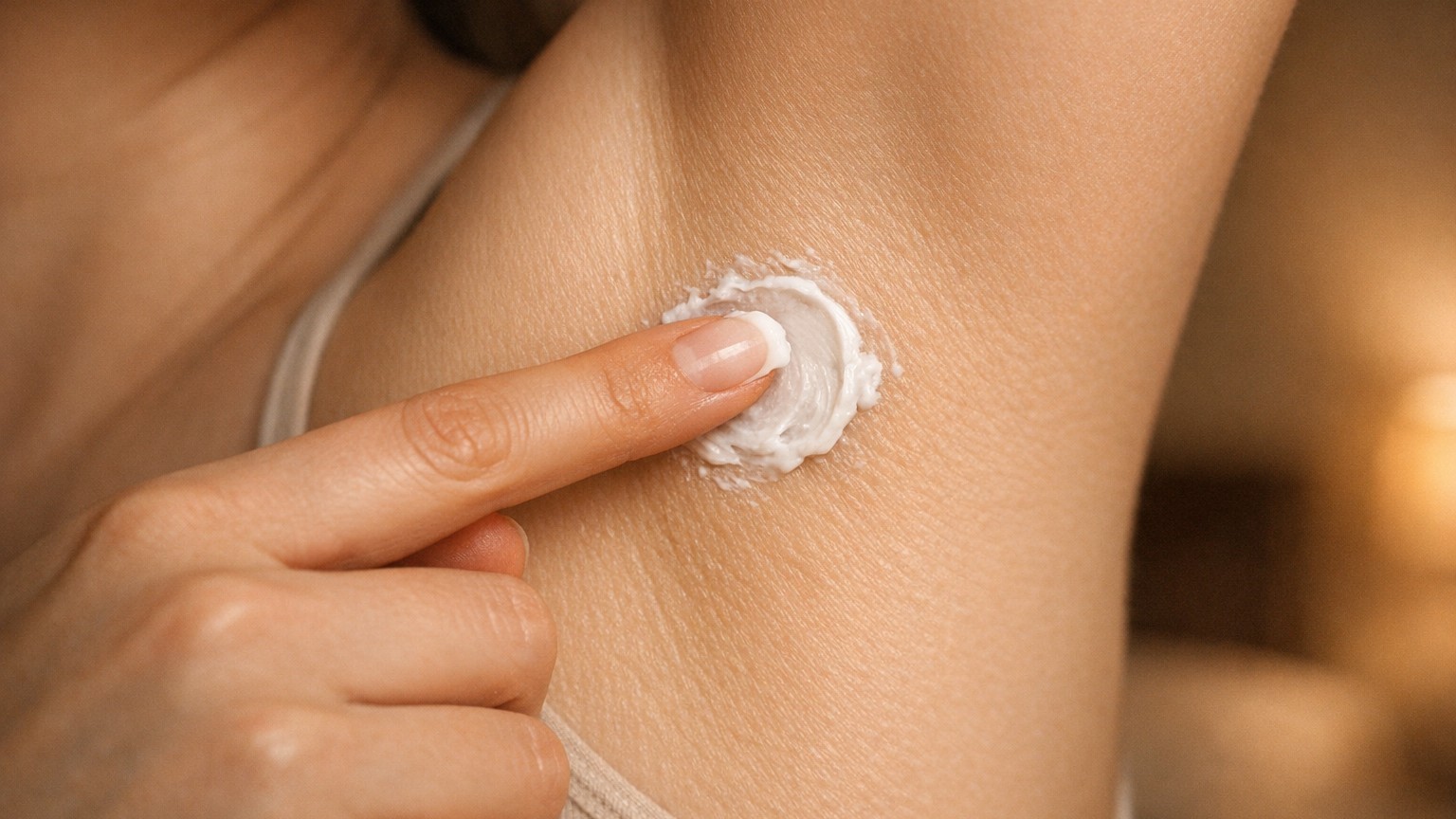
Every morning, the same ritual: shower, dry off, swipe on deodorant. Then, reliably, somewhere between 11am and noon, the subtle, unwelcome return of body odor. The product hasn’t failed you. You have. And your timing has.
A single conversation with a dermatologist changes everything. The science behind deodorant and antiperspirant effectiveness is decades old, it just never made it to the back of the stick.
Key takeaways
- Sweat itself is odorless—it’s bacteria that creates the smell, and most people use the wrong product for their goal
- Morning application is scientifically proven to be the least effective time, but dermatologists have a surprisingly simple solution
- A clinical study showed evening-only application outperforms morning-only by a significant margin—and there’s a reason most people don’t know this
Sweat Doesn’t Smell. Bacteria Does.
It’s a common misconception that sweat smells. Sweat is, in fact, a clear, odorless liquid. The real culprit is far more microscopic. The production of body odor in humans is a process in which microbes on the skin play a central role, through their bioconversion of odorless secreted molecules into volatile odorants. These precursor molecules are produced by the apocrine glands, which are associated exclusively with hair follicles in specific sites like the underarm and genital regions.
Eccrine glands are found all over the body and produce a watery sweat, while apocrine glands, located in areas like the armpits, produce a thicker sweat that bacteria love to feast on. The result? A very specific, very recognizable smell by midday, not because you’re dirty, but because a thriving microbial community has been hard at work since you left the house.
This is where the deodorant-versus-antiperspirant distinction becomes non-negotiable. Antiperspirants are designed to reduce sweating. They work by temporarily blocking the sweat glands, which reduces the amount of sweat that reaches the skin’s surface. The active ingredient in most antiperspirants is aluminum-based compounds, such as aluminum chloride or aluminum zirconium, which form a temporary plug within the sweat duct, stopping the flow of sweat to the skin’s surface. Deodorants, on the other hand, are formulated to combat body odor. They don’t stop you from sweating but instead target the bacteria that cause odor when sweat interacts with your skin. Deodorants often contain antimicrobial agents to kill bacteria and fragrances that mask any unpleasant smells.
Applying a deodorant every morning and expecting all-day protection is like putting on a raincoat after you’re already soaked. The product addresses the smell. The antiperspirant addresses the source. Most people are using one thinking it does the job of both.
The Morning Routine Is the Problem
Applying deodorant in the morning, especially after a hot shower or during active hours of the day, can be less effective. Sweat can dilute the product before it has time to work properly, and the moisture on your skin may hinder absorption. This detail alone reframes years of bathroom habits.
The biggest reason antiperspirants fail is that they are not on the skin long enough to produce a coagulated keratin plug in the sweat duct to inhibit the release of sweat onto the skin surface. Think of it less like applying a fragrance and more like a slow-acting treatment. Some people use an antiperspirant for two to three days and then claim failure, when it actually takes ten days of antiperspirant use to achieve a substantial keratin plug. An antiperspirant must be used a minimum of ten days prior to determining if success has been achieved.
Ten days. Most people give up after two, convinced the product doesn’t work, when really, the method was always off.
It’s also important for the skin to be dry when the antiperspirant is applied; otherwise, sweat will dilute the antiperspirant and it will fail due to insufficient concentration. This is why bedtime application is best. At night, your body temperature drops and you tend to sweat less. Applying antiperspirant at night, when your sweat glands are less active, means it is easier for it to absorb into the skin than it is in the morning.
What Dermatologists Actually Recommend
According to the American Academy of Dermatology, the best time to apply an antiperspirant is before bedtime. The active ingredients of antiperspirants, including aluminum-based compounds, may work better when they have a chance to work overnight. This isn’t a fringe opinion from a wellness blog, it’s the official position of the country’s leading dermatology authority, and it directly contradicts the habits of most Americans.
When applied to dry, clean skin before bed, the active ingredients have plenty of time to be absorbed and form plugs in your sweat glands, reducing sweat production. By morning, the antiperspirant has already had several hours to take effect. The effects of antiperspirants typically last for 24 hours, meaning even if you shower the next morning, the protection remains. That’s the detail that stuns most people. You can shower in the morning and the overnight protection is already locked in.
A published clinical study in the Journal of the American Academy of Dermatology confirmed the gap in a controlled setting. Sixty female subjects between the ages of 18 and 65 were divided into three groups: the first received treatment in the morning only, the second in the morning and evening, and the third only in the evening. Evaluation of percent sweat reduction after three, seven, and ten days of treatment showed that evening and twice-daily application are significantly more effective than morning-only application. The morning group, the one that most closely mirrors how the majority of women use these products, consistently performed the worst.
For those who want maximum coverage, for combination products, dermatologists suggest choosing between which effect you want to be stronger, the sweat-blocking plug or the deodorizing fragrance. Alternatively, applying them twice a day is also a valid option.
The Right Way to Reset Your Routine
Your body temperature is lower at night, which means you produce less sweat while sleeping. With less moisture on the skin’s surface, the active ingredients can settle into sweat ducts more effectively. The protocol is simple: clean, completely dry underarms before bed, a thin and even layer of antiperspirant, and patience for roughly ten days while the plugs build.
The antiperspirant must also be used on a daily basis to maintain the plug, which will disappear fourteen days after the last application. Consistency isn’t optional, it’s the mechanism. Missing a few days doesn’t just reduce effectiveness for that day; it dismantles progress that took nearly two weeks to build.
One more thing worth knowing: hair traps sweat and bacteria, which can lead to increased odor. Shaving or trimming underarm hair can help reduce these issues and allow your deodorant to perform more effectively. And if irritation has always been an issue with your current product, the timing may be partly to blame. Many people notice stinging or redness when they use deodorant on damp skin. If deodorant makes your underarms burn, itch, or peel, the timing is often part of the problem, not just the formula.
There’s also something quietly interesting happening at the frontier of odor science. Since the composition of the skin microbiome is such a strong driver of body odor, some researchers are now investigating whether applying probiotics, non-odor-causing bacteria, to the skin can help subdue the stench. The future of your deodorant shelf might look less like a drugstore aisle and more like a fermented skincare counter.