
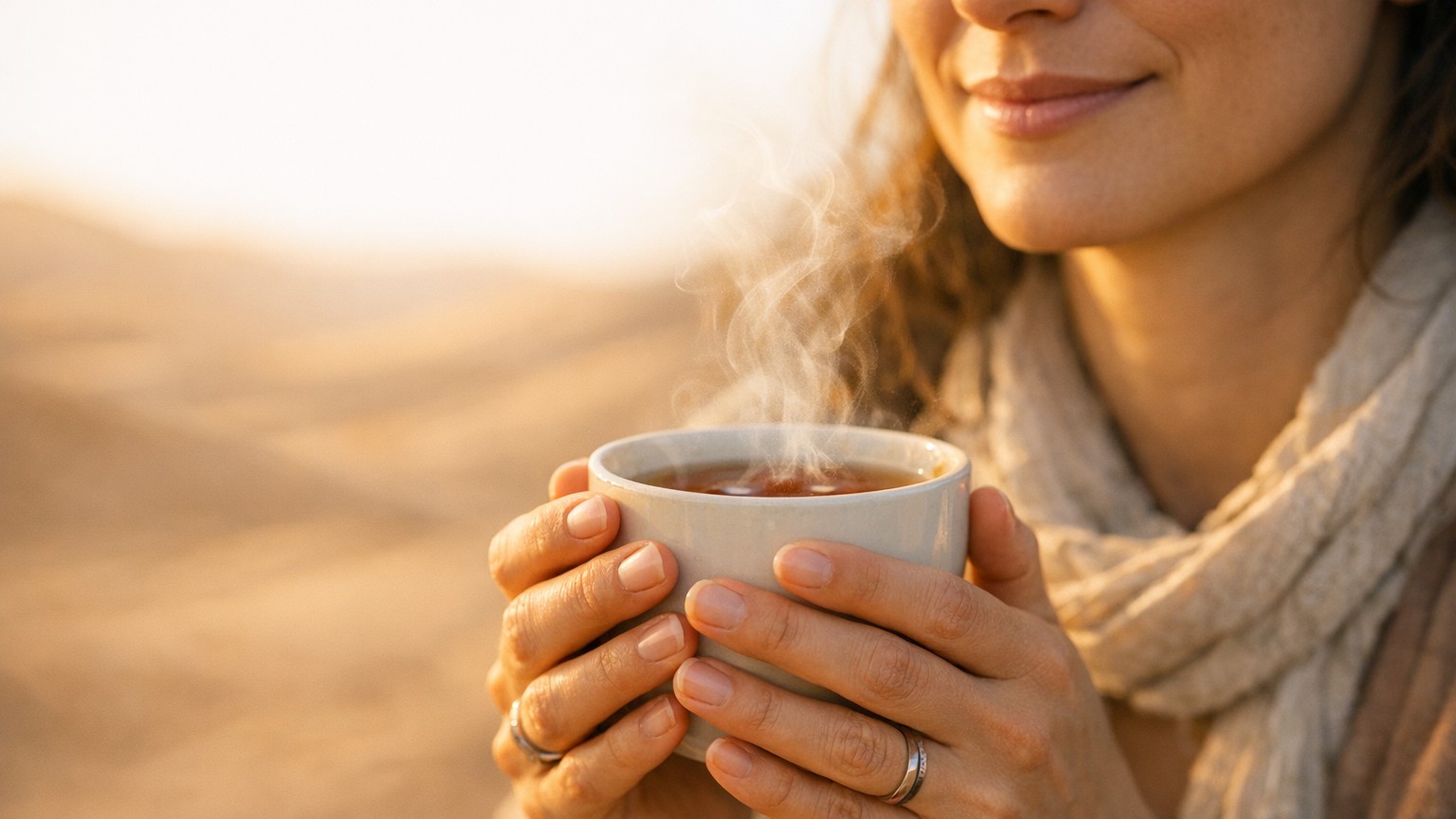
Every summer, the same reflex: the moment the heat turns aggressive, you grab the tallest glass you can find, fill it to the brim with ice water, and drink. Fast. The cold hits, there’s a fleeting second of relief, and then, nothing. Five minutes later, you’re already sweating again. Turns out, a Bedouin nomad in the Sahara understood something about your body that modern refrigerators made us forget entirely.
Key takeaways
- A landmark study reveals hot beverages can reduce body heat storage more effectively than cold water—but only under specific conditions
- Ice water forces your body to expend extra energy just to neutralize the temperature difference, potentially pushing you toward overheating
- The critical variable that changes everything: humidity and sweat evaporation
What the Desert Already Knew
The Bedouin, nomadic people of the Middle Eastern and North African deserts, have a tradition that looks almost absurd to Western eyes: they drink hot tea in the scorching heat of summer, and this custom is deeply rooted in cultural heritage and serves multiple purposes for their survival in the harsh desert environment. Not iced. Not lukewarm. Boiling. They have a long tradition of drinking so-called Bedouin tea, a strong, sweet black tea. The same pattern shows up in Morocco, India, Saudi Arabia, Japan. Many of the leading consumers of tea per capita are in tropical or desert regions, and chai is one of the most popular drinks in India. These aren’t people who lack access to cold water. This is a deliberate, centuries-old physiological strategy.
Bedouins drank hot tea as a survival strategy: hot liquids signal the body to cool itself through sweating, which evaporates and cools the body more effectively than cold water. Tea also hydrates smoothly without causing cramps. They also drank salted tea or herbal infusions from desert plants like sage or chamomile to replace electrolytes. The cup wasn’t just comfort, it was engineering.
The Science That Backs Up Centuries of Nomadic Wisdom
A landmark 2012 study published in Acta Physiologica by researchers at the University of Ottawa’s School of Human Kinetics found that drinking hot beverages in warm, dry conditions can reduce overall body heat storage more effectively than drinking cold beverages. The mechanism is thermoregulatory: hot liquid raises core body temperature slightly, which triggers the hypothalamus to increase sweat production. As this additional sweat evaporates from the skin, it removes more heat from the body than the hot liquid added, creating a net cooling effect.
According to Professor Peter McNaughton, a neuroscientist at the University of Cambridge, consuming hot beverages will raise your core body temperature and makes you sweat at an increased rate. Nerves in your mouth and upper digestive tract respond to the heat of the beverage, stimulating the brain to produce more sweat. As it evaporates, the sweat effectively cools you down. The key word here is evaporate. That detail changes everything.
The University of Ottawa team’s data showed that those drinking hot water stored less heat in their bodies than the others. There is a critical caveat, though, it has to do with how our bodies dissipate heat: by sweating. As researcher Dr. Ollie Jay put it, “If you drink a hot drink, it does result in a lower amount of heat stored inside your body, provided the additional sweat produced when you drink the hot drink can evaporate.” In a dry climate, a desert, an air-conditioned room, a breezy patio, that condition is easily met. In dry heat conditions, the ones we mostly encounter, a hot cup of tea will have better long-term cooling effects than a glass of iced tea.
What Ice Water Actually Does to Your Body
Here’s the part that changed my habit completely. The cold glass of water you’re reaching for may be working against you in ways you never considered.
Drinking ice water or cold water hampers the process of digesting food as it causes your blood vessels to shrink. This restricts blood flow to the digestive system, in effect weakening digestive function. When you drink very cold liquids, the body must expend energy warming them to core body temperature before they can be fully absorbed by the digestive system. So while you feel the immediate jolt of refreshment, your body is quietly burning extra resources just to neutralize what you drank.
When we drink cold water in summer, our bodies have to compensate for the difference in temperature by heating up more, which can lead to overheating. Drinking warm drinks allows the body to relax, calm down, and cool itself to a normal homeostatic temperature without needing to compensate for the difference in temperature. The counter-intuitive reality: that icy sip can quietly push your body toward exactly the overheating you were trying to avoid.
One more thing that rarely gets mentioned: while caffeine has a mild diuretic effect in isolation, research published in PLOS ONE found that tea consumed in normal quantities (up to 6 cups per day) is equally as hydrating as an equivalent volume of water. The fluid volume in each cup of tea far exceeds the small amount of additional fluid loss caused by caffeine’s diuretic effect, resulting in a net positive contribution to hydration. The old fear about tea being dehydrating? Largely unfounded.
When Hot Tea Doesn’t Work : And What to Drink Instead
None of this is a universal prescription. The crucial variable is humidity. The cooling advantage of hot drinks is most effective in dry environments where sweat can evaporate freely. In very humid conditions (above 80% relative humidity), sweat evaporation is significantly reduced, which means the cooling benefit of hot drinks is diminished. On a sticky August afternoon in New Orleans or Miami, you’re not a Bedouin, you’re in a steam bath. “On a very hot and humid day, if you’re wearing a lot of clothing, or if you’re having so much sweat that it starts to drip on the ground and doesn’t evaporate from the skin’s surface, then drinking a hot drink is a bad thing,” says Dr. Jay.
During extreme heat events, temperatures above 100°F with high humidity, the priority should be rapid cooling and aggressive hydration using whatever temperature beverage you will consume in the greatest quantity. There’s no dogma here. The goal is always hydration first, cooling second.
The Berbers of the Sahara drink boiling mint tea, a ritual that, despite its paradoxical appearance, stimulates sweating and thus helps cool the body. Mint, specifically, adds another layer: its menthol compounds create a perception of coolness on mucous membranes, offering a psychological refreshment on top of the physiological one. A cup of hot peppermint tea in dry summer heat is, by that measure, working on two fronts simultaneously.
The summer I started keeping a small kettle on the kitchen counter instead of a Brita filter in the freezer was the summer I stopped feeling flattened by afternoon heat. The ritual slowed me down too, five minutes of quiet while the water boiled, the steam rising, the small ceremony of pouring. For the Bedouin, tea was also a social ritual involving hospitality and storytelling. Maybe that enforced pause is part of the cooling too. Hard to overheat when you’ve stopped rushing.
Sources : the-tea-crane.com | qz.com