
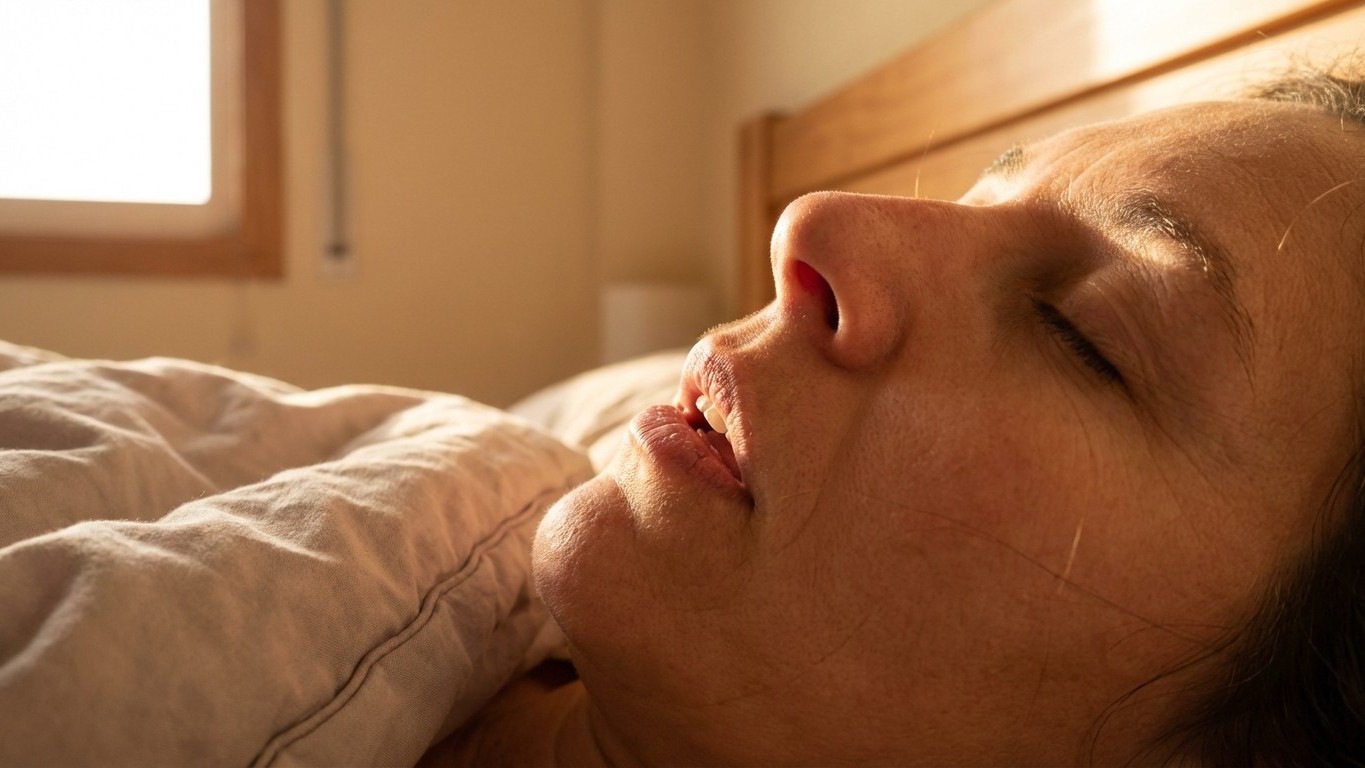
That sticky, sandpaper-dry feeling the moment you open your eyes. The kind of thirst that a full glass of water barely fixes. If this is your morning ritual, you are probably not thinking about your teeth. But your dentist is.
If your mouth often feels dry when you wake up, you may be breathing through your mouth during the night. The reflex is silent, invisible, and completely unconscious. You will never catch yourself doing it. And that is precisely what makes it so damaging.
Key takeaways
- Your teeth are being damaged while you sleep—but you’ll never catch yourself doing it
- Eight hours of mouth breathing creates an acidic environment that dissolves tooth enamel and feeds cavity-causing bacteria
- That dry morning mouth might signal a larger airway problem your body is literally grinding your teeth to solve
What Actually Happens to Your Mouth While You Sleep
Saliva is, without exaggeration, one of the most underestimated substances in the human body. It plays a critical role in protecting teeth by Washing away food particles and neutralizing acids, without it, you face a much greater risk of cavities, gum disease, and bad breath. At night, saliva production naturally slows down. Now add mouth breathing to that equation.
When you sleep breathing through your mouth, it creates a more acidic environment in your oral cavity compared to nose breathing. This drop in pH levels can gradually damage your tooth enamel, making your teeth more sensitive to hot and cold temperatures and significantly increasing your risk of developing cavities over time. Think about that: eight hours, every night, your enamel quietly dissolving under the wrong conditions. The result. Cumulative and very real.
Researchers observed a group of people who breathed through their mouth versus those who breathed through their nose. The mouth-breathing group accumulated more plaque on their teeth, and they were also much more likely to have large colonies of Streptococcus mutans, a type of bacteria that is associated with tooth decay. Not just a little more, significantly more.
The gums are not spared either. Bacteria thrive in dry conditions, and with decreased saliva, they can easily accumulate along the gumline. This often leads to gingivitis, the early stage of gum disease. If left untreated, it can progress to periodontitis, a severe form of gum disease that damages gum tissue and the underlying bone, potentially leading to tooth loss. A dry morning mouth is not a cosmetic inconvenience. It is a signal.
The Sleep Problem Hidden Inside the Breathing Problem
Here is the counterintuitive part. Most people assume that if they snore or sleep badly, it is a sleep issue. They buy a new pillow, try white noise, cut back on screen time. What they rarely consider is that their jaw, tongue, and airway might be running the show.
Mouth breathing caused by an obstruction of the upper airway can result in bruxism (wear and fracture of teeth), temporomandibular disorder of the jaw joints, erosion of the teeth, malocclusion, and periodontal disease. Beyond the dental implications, upper airway obstructions can lead to sleep-disturbed breathing, which causes headaches, snoring, and difficulty sleeping.
Bruxism is an oral para-functional activity of teeth grinding and jaw clenching. As muscles of the body relax during sleep, the tongue, resting low in the mouth, can fall backward and obstruct the airway. The brain responds by sending Signals to the jaw to slide forward, opening the airway to allow air in. Unfortunately, this sliding of the lower jaw against the upper jaw causes abrasive grinding of tooth surfaces. So your body is literally grinding your teeth to keep you breathing. Quietly. Every night.
Research has associated obstructive sleep apnea with heightened risks of bruxism, dry mouth, periodontal disease, temporomandibular joint disorders, palatal and dental changes, and even alterations in taste sensation. The mouth is reading your sleep quality in real time, and leaving a record of it.
What Is Causing It (And Why You Might Not Know)
Many people do not realize they are chronic mouth breathers, especially during sleep. Nasal congestion, allergies, or anatomical issues often force breathing through the mouth instead of the nose, creating a harmful environment for teeth and gums. The causes range from seasonal allergies and sinus infections to a deviated septum, when the thin wall of tissue separating your nostrils is off-center, one or both nostrils can be blocked, which makes nasal breathing difficult and results in mouth breathing.
Sometimes, mouth breathing becomes a habit even after the original cause is resolved. That is the part no one warns you about. You had a bad cold three winters ago, and your body just… kept the pattern. The nervous system learns what works and holds on.
As we age, our natural saliva production often decreases, making the additional drying effects of mouth breathing even more damaging to dental health. For women over 40, this is worth knowing. The intersection of hormonal changes, lower baseline saliva production, and nighttime mouth breathing compounds risk in ways that a twice-a-year cleaning may not catch quickly enough.
What You Can Actually Do About It
The internet, predictably, has an answer: mouth taping. The trend exploded on TikTok, promising better sleep, fresher breath, and cleaner teeth by simply sealing your lips with adhesive tape at night. The reality is more complicated.
There have been very few studies on mouth taping to show whether it can treat or prevent any issues related to mouth breathing. Doctors and dentists do not recommend mouth taping because there is not enough scientific evidence to show it works. Worse, oral occlusion through taping, sealing, or chin strapping could pose a serious risk of asphyxiation in the presence of nasal obstruction or regurgitation. If your nose is even partially blocked, forcing your mouth shut could restrict airflow dangerously.
As one Cleveland Clinic doctor put it: “Mouth taping seems like a solution, but it’s only a short-term fix for what might be a larger problem with your airways. Before trying mouth tape, talk to your doctor about what’s really going on.” Sensible advice, even if it lacks the viral appeal of a TikTok.
The smarter approach starts upstream. Using a humidifier at night can add moisture to the air and help prevent dry mouth while you sleep. Practicing breathing exercises or using nasal strips can also encourage nasal breathing and help break the habit. For structural issues like a deviated septum, an ENT consultation is worth the appointment. For many patients with sleep-related breathing disorders, custom dental appliances offer an effective and comfortable alternative to CPAP machines, designed to maintain an open airway during sleep by repositioning the lower jaw and tongue.
And yes, the basics matter more than you think. The American Dental Association recommends brushing your teeth and tongue twice daily using a fluoride toothpaste and flossing once a day, along with regular dental checkups and teeth cleanings at least once a year. When mouth breathing is in the picture, that frequency becomes a floor, not a ceiling.
The most important step is also the least glamorous: tell your dentist about that dry mouth. Mouth breathing patients may report symptoms such as dry lips and mouth, snoring and open-mouth sleeping, chronic bad breath, and swollen, red gums that bleed easily. Any one of these is enough to start the conversation. Your mouth is Trying to Tell You something, and the question is whether you are curious enough to listen.