
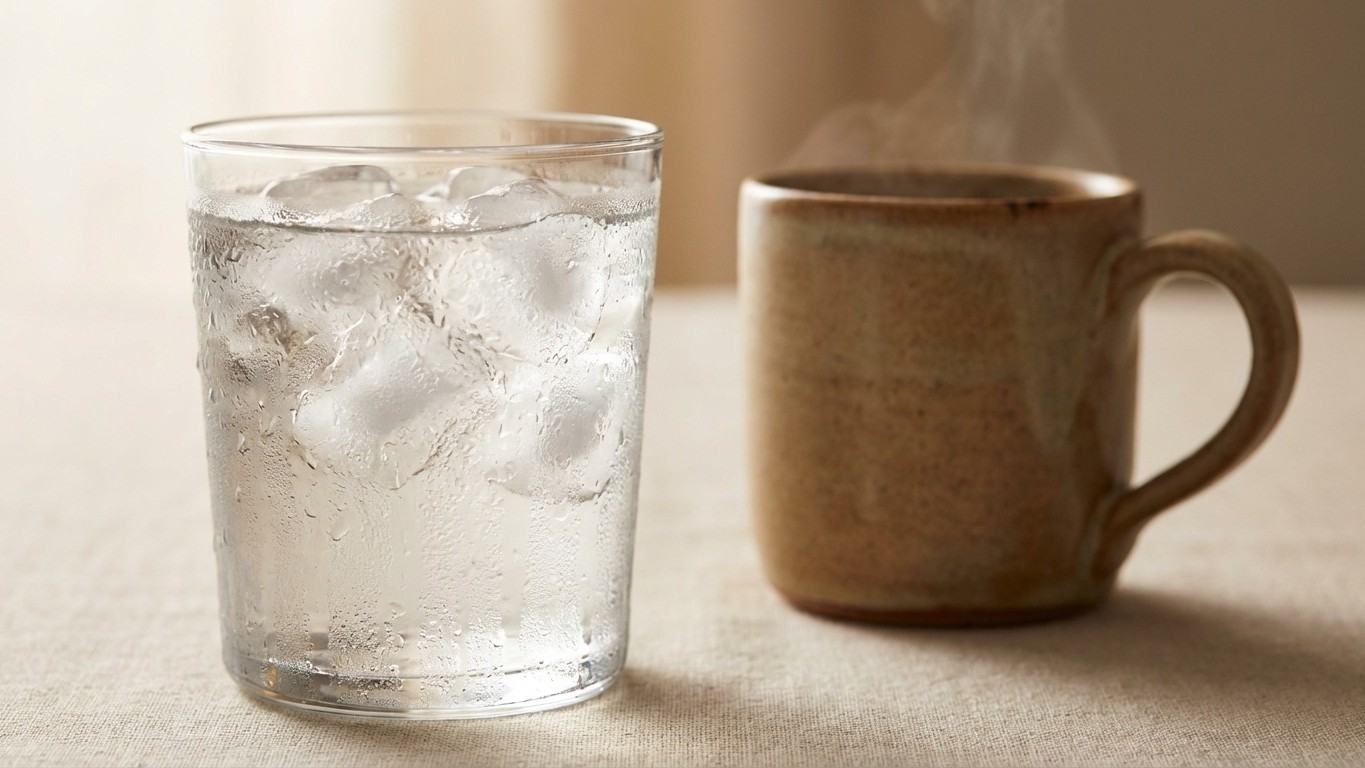
The idea has been circulating in wellness circles for years: drink a glass of ice water with your pasta Bolognese or slice of salmon, and the dietary fats on your plate will quietly harden inside your stomach, slowing digestion, clogging your system, forming a kind of internal sludge. It’s a vivid image. It’s also, for most healthy people, not exactly what happens, though the real story is more nuanced than a flat “myth or fact” verdict.
Key takeaways
- A widespread wellness myth claims ice water solidifies stomach fat, but your body’s thermal regulation defeats this within minutes
- Cold water does suppress stomach contractions and slow digestion—but this effect varies dramatically depending on your digestive health
- If you have IBS, acid reflux, migraines, or gastroparesis, warm water may genuinely help; for most healthy people, temperature barely matters
What Actually Happens When Ice Water Meets Your Stomach
The average body temperature sits around 37°C (98.6°F), significantly warmer than a chilled glass of water, which may hover between 4–10°C (39–50°F). The moment that ice water hits your stomach, your body kicks into thermal regulation mode. The cold water quickly absorbs body heat, and studies show that ingested liquids rapidly adjust to internal temperature, usually within minutes. The stomach, is a remarkably efficient warming machine.
Research published in the American Journal of Physiology confirms that liquids consumed at any temperature quickly equilibrate to body temperature within minutes of reaching your stomach. So the image of frozen fat globules lurking in your gut? While cold water might momentarily lower the temperature of the stomach lining, it does not remain cold long enough to solidify fats or disrupt digestive enzymes. The solidification claim, though appealingly alarming, doesn’t hold up under physiology.
That said, dismissing Everything about water temperature at mealtime as pure fiction would be a mistake.
The Real Effects : Slowed Emptying, Suppressed Contractions
Here’s where things get genuinely interesting. Intragastric temperature returns to body temperature within 20–30 minutes of ingesting cold drinks, but warm and cold drinks alike appear to empty from the stomach more slowly than a control drink at body temperature, and the initial rate of gastric emptying of a cold drink is significantly slower. Slower, not stopped. A meaningful distinction.
A study found that consuming 500 mL of water at 2°C suppressed gastric contractions and ad libitum energy intake compared with consuming the same amount at 37°C and 60°C. Translated from lab language: very cold water before or during a meal quiets down the muscular churning of your stomach, and that suppression is directly linked to eating less. Subjective appetite perception of hunger also tended to be lower after consuming cold water at 2°C than after hot water at 60°C. This is the paradox nobody talks about, ice water may actually help you eat less, not because fat hardens, but because your stomach temporarily stops its pumping rhythm.
Slowing gastric emptying can sometimes be beneficial, as it prolongs satiety and prevents rapid spikes in blood sugar after meals. A slower digestive transit, in certain contexts, is not a flaw in the system, it’s a feature. The body managing its glucose response. The problem is that this nuance gets completely lost when wellness accounts on social media reduce Everything to “ice water solidifies fat, stop drinking it.”
Who Should Actually Pay Attention
Multiple studies have examined whether water temperature affects digestive function, and the results consistently show that cold water does not impair normal digestion in healthy individuals. For the majority of women reading this over lunch, no, your iced sparkling water is not wrecking your digestion.
But “healthy individuals” is doing a lot of work in that sentence. Research from 2001 found that drinking ice-cold water could be a trigger for people with migraine, and a 2012 study found that pain due to achalasia, a condition limiting the body’s ability to pass food through the esophagus — can worsen when cold water is consumed with a meal. For those with IBS, acid reflux, or gastroparesis, ice-cold water can tighten the stomach muscles, potentially leading to cramps, bloating, or delayed digestion, and warm or room-temperature fluids are a smarter choice.
A study comparing the gastrointestinal effects of food intake at varying temperatures in 50 patients with functional dyspepsia found that hot meals “significantly accelerated gastric emptying.” For that population, temperature is not a trivial variable. It’s a therapeutic one.
Some research indicates that cold liquids may slightly slow the rate of gastric emptying, how quickly the stomach sends food and fluids into the small intestine — but this effect is usually mild and not clinically significant for most healthy individuals. The key phrase: most healthy individuals. Not everyone at the table.
The Warm Water Tradition Has a Point (Just Not the One It Claims)
In traditional Chinese medicine, drinking cold water with hot food is believed to create an imbalance, and meals in Chinese culture are typically served with warm water or hot tea. Ayurvedic medicine similarly suggests that cold water can weaken “agni,” the digestive fire responsible for breaking down food. These traditions predate modern gastroenterology by centuries, and they shouldn’t be dismissed as folklore simply because their mechanisms were imprecisely described.
Warm water supports digestion by keeping the digestive muscles relaxed and allowing food to move through the stomach and intestines more efficiently. Warm water can also stimulate peristalsis, the muscular contractions that move contents through the gut, which aids digestion. The wisdom is real. The science just frames it differently than ancient texts did.
The counter-intuitive conclusion here: the people who are probably overthinking their water temperature the most, healthy women without digestive conditions, sipping ice water with a balanced meal — have the least to worry about. Digestive enzymes such as lipase, amylase, and protease continue their function normally as the fluid reaches body temperature. Meanwhile, those who could genuinely benefit from switching to warm water with meals (people with IBS, reflux, dyspepsia, or migraines) are often the ones not asking the question at all.
One detail that almost never surfaces in this conversation: a 1978 study found that consuming cold water thickens nasal mucus, making it harder to pass through the respiratory tract, which means if you’re fighting a winter cold, that tall glass of ice water is actively making your congestion worse, completely independently of your digestion. The stomach isn’t the only system involved.
Sources : betterhealthfacts.com | skumawater.com