
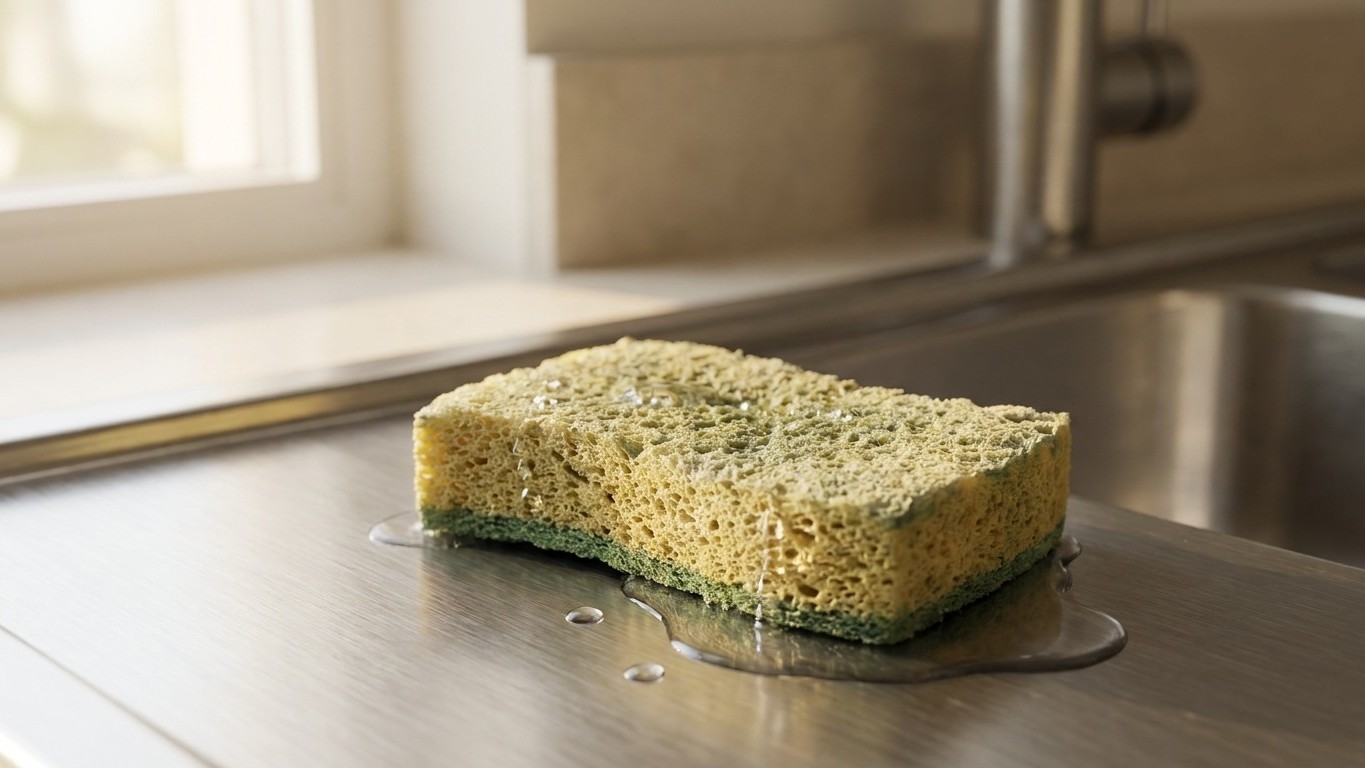
The kitchen sponge sitting beside your sink right now may be the single most bacterially dense object in your home. Not the toilet handle. Not the trash can lid. The sponge. A landmark 2017 study published in Scientific Reports by microbiologist Markus Egert and his team at Furtwangen University found something genuinely staggering: “the density of bacteria reached up to 45 billion per square centimeter” on used kitchen sponges. For context, that’s roughly comparable to human intestinal bacteria concentrations. The object you’re using to “clean” your dishes may be one of the least clean things in your house.
Seven days. That’s about how long the science gives you before the situation becomes harder to manage. The clock starts the moment you first wet that sponge.
Key takeaways
- A single kitchen sponge can contain bacterial concentrations comparable to human intestines
- Microwaving kills 99.99999% of bacteria but leaves billions behind—and may select for tougher, more dangerous strains
- After day 7, no sanitization method can reliably reset the sponge; replacement is the only solution
What Actually Happens Inside a Sponge Over Time
Kitchen sponges are a perfect place for bacteria to live and grow, because the sponges have tiny holes that hold water, food bits and food juices that bacteria need to survive. One Duke University researcher described the structure as “tiny rooms within rooms,” where there are plenty of extra places for bacteria to attach. That physical architecture, an interconnected maze of micro-cavities, is precisely why a sponge is so much harder to sanitize than a flat surface like a cutting board.
Harmful bacteria such as E. coli, Salmonella, and Staphylococcus aureus can survive and persist for up to 16 days on a kitchen sponge. Sixteen days. That number, from research presented at the American Society for Microbiology, should recalibrate everything about how long you keep that thing around. The bacteria aren’t passively sitting there, either. A sponge provides an ideal environment for pathogens to multiply, offering warmth, moisture, and lots of “food.”
The cross-contamination angle is what makes this genuinely consequential for your health. A study found that more bacteria transferred when the “dirty” sponge was used with more force, scrubbing harder freed more bacteria from the sponge to transfer to the other surface. So the harder you scrub your plates, the more you’re potentially redistributing a microbial ecosystem across your kitchen.
The Microwave Myth : Partially True, and That’s the Problem
Here’s where the conventional wisdom falls apart. Yes, microwaving kills bacteria. Microwaving sponges killed 99.99999 percent of bacteria present on them, while dishwashing killed 99.9998 percent of bacteria, according to USDA research. Those numbers sound excellent. But they miss the point entirely.
Microwaving the sponge will knock down the bacteria living in it by about a million-fold, but this method will leave many still alive since there are billions in the sponge. A million-fold reduction of 45 billion is still 45,000. And those survivors aren’t random. Regularly sanitized kitchen sponges did not contain less bacteria than uncleaned ones, which is probably due to rapid recolonization of the sponge tissue. The authors further suggested that regular cleaning might even select for higher proportions of potentially pathogenic and malodor-producing bacteria.
That’s the counterintuitive finding most people never hear about. “We think that this is a kind of selection phenomenon, by cleaning, you select the more resistant bacteria,” Egert explained. Your microwave routine may be creating a more hostile bacterial environment, not a cleaner one. The weakest microbes die; the tougher, more heat-resistant strains thrive. Regular cleaning of sponges significantly affected the microbiome structure, with two dominant bacteria showing significantly greater proportions in regularly sanitized sponges, “thereby questioning such sanitation methods in a long-term perspective.”
That said, microwave treatment is still worth doing between replacements, it just isn’t a substitute for replacement itself. The heat targets the dangerous pathogens most likely to make you sick, which tend to be less heat-resistant. Some spores and heat-resistant bacteria may survive, particularly in denser types of sponges. The key word is “between.” Sanitizing extends the useful life of a sponge slightly; it does not reset the clock.
The Seven-Day Line and What Science Recommends Instead
A good rule of thumb is to replace a kitchen sponge at least once a week. “I wouldn’t go longer than a week without replacing a sponge,” says cleaning expert Melissa Maker. Multiple food-safety organizations land in the same territory. “In view of the trillions of germs inside a sponge, probably no domestic method will eradicate all of them, and after a few days or maybe even hours, the sponge is recolonized again,” said microbiology instructor Phillip Delekta, Ph.D., of Michigan State University.
A few practical rules make a real difference in the days before that weekly swap. Practices found to prevent Salmonella growth in sponges include a habit of changing the sponge when it is worn and not storing the sponge in the sink. Leaving a wet sponge sitting in a pool of sink water is essentially a bacterial incubator. Store it upright somewhere it can actually dry between uses, that single change reduces bacterial buildup meaningfully. Using separate sponges for counters, bathroom, and dishes avoids cross-contamination of bacteria and allows them to remain dry for longer periods of time.
For those willing to rethink the sponge entirely, the science points clearly in one direction. Brushes are more hygienic than sponges and their use should be encouraged, concluded a study published in the International Journal of Food Microbiology. The reason is structural: drying of sponges is difficult to obtain if sponges are used daily, while brushes dry between uses, dramatically reducing bacterial survival. Several recent studies have found that bacteria grow and thrive better in sponges than kitchen brushes because brushes dry faster than sponges and may be less of a friendly environment for germs.
There is one nuance worth holding onto, especially if you’re healthy and not immunocompromised: a study detected pathogens in only about 1 to 2 percent of sponges collected from kitchens in Philadelphia, and even then, the amount of the pathogens present was very small. The microbial density in a used sponge is real and significant; the actual risk of getting sick is lower than the headlines suggest. But if you’re immunocompromised or have an infant in the house, you do want to be a little more careful about bacterial exposure, and it may make sense to think about how to avoid spreading the sponge bacteria onto everything else.
The real problem with the kitchen sponge isn’t that it’s secretly plotting against you, it’s that we treat it like a permanent kitchen fixture rather than a short-lived consumable. Bacteria don’t actually care about the arbitrary boundaries of a seven-day week. What they care about is warmth, moisture, and food residue. And on day eight, they’ve simply had more time to make themselves at home than on day one. Whether the swap happens on day seven or day nine is less important than understanding that the sponge you’re using to “clean” your kitchen has a shorter useful life than the yogurt in your fridge.
Sources : enviromicro-journals.onlinelibrary.wiley.com | canr.msu.edu