
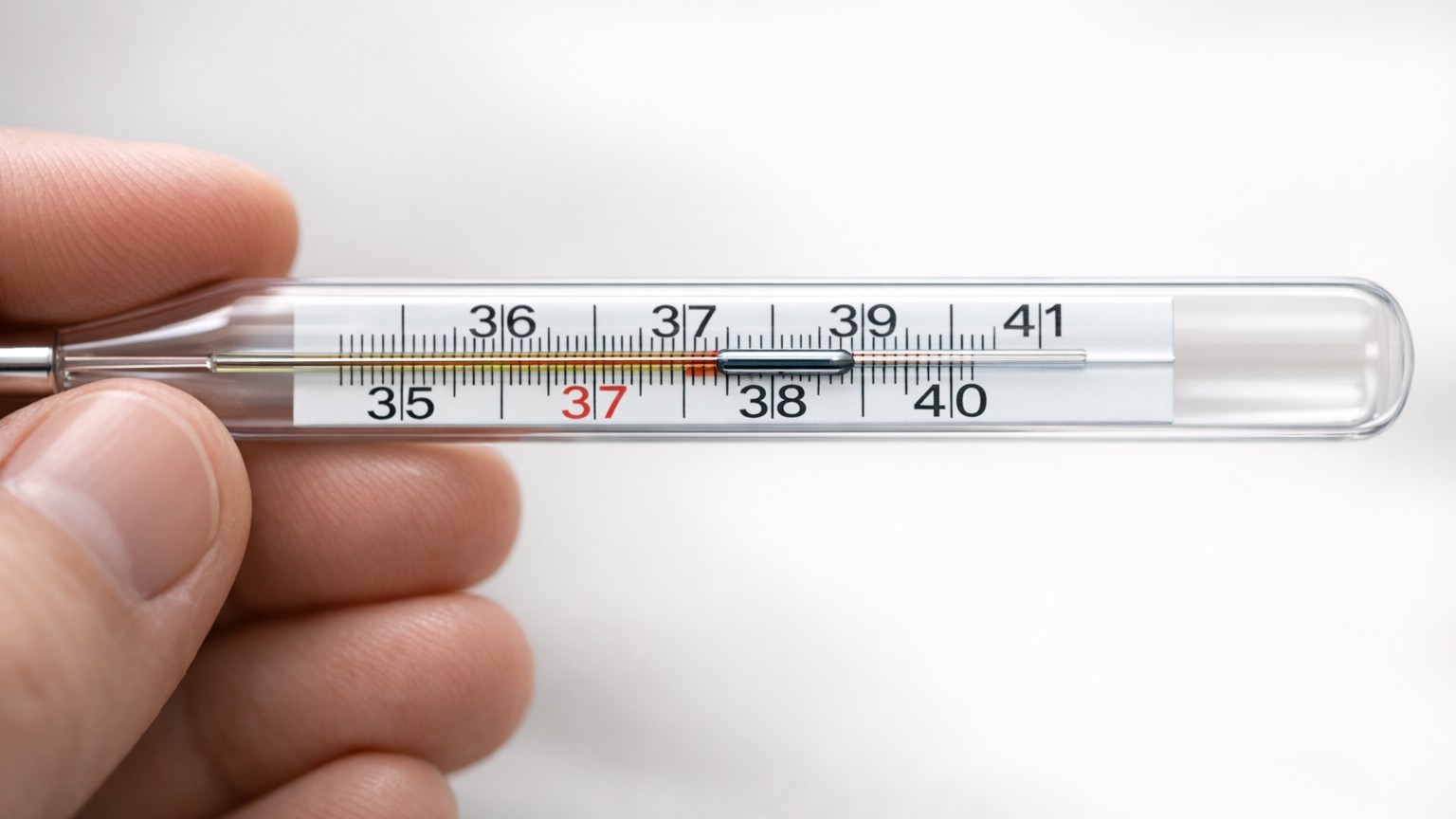
A thermometer reading 38.1°C. Just a degree above normal, barely worth mentioning, right? Most of us shrug it off, blame the weather, a bad night’s sleep, or the summer heat. The problem is that this tiny number, quietly sitting above the critical threshold, is actually your body sounding a structured biological alarm. And dismissing it can cost you time you may not have.
Key takeaways
- Your body deliberately raises its temperature to create a hostile environment for infection—but what’s causing the fever matters more than the fever itself
- Up to a third of elderly patients with serious infections show little to no fever, making them the most vulnerable population to being dangerously misdiagnosed
- The temperature threshold that changes everything: when 38°C becomes an emergency warning instead of just ‘the heat’
What 38°C Actually Means to Your Body
A fever is defined as a temporary rise in body temperature above 38°C (100.4°F). It is not an illness in itself, it is a symptom of an underlying condition, most commonly an infection. That distinction matters enormously. The fever is not the enemy. It is the messenger.
Raising your body temperature makes it harder for certain viruses and bacteria to survive. Think of it less like a malfunction and more like a deliberate thermostat adjustment, Your Immune System turning up the heat to make life hostile for whatever has invaded. Your immune system releases inflammatory chemicals that increase your core temperature. That higher temperature makes it very uncomfortable for the virus to live. Your body is literally trying to cook the virus out.
Here is the counterintuitive truth that most people miss: a fever is not a sign that something has gone wrong with your body. It is a sign your body is doing its job. What matters is what’s causing it, and how long it lasts.
During a fever, your body uses more oxygen, increases your heart and respiratory rates, and uses more protein as an energy source. Your Immune System goes into overdrive, and your white blood cells become more active, helping your cells respond quicker against the infection. The exhaustion you feel? That’s not weakness. That’s your entire system redirecting energy toward one single fight.
The Readings That Should Change Your Response
Fevers are divided into low-grade and high-grade. Low-grade fevers are between 38°C (100.4°F) and 38.9°C (102°F), usually from mild sicknesses that can be treated with medicine and rest. High-grade fevers are over 39°C (102.2°F), and they signal a more serious infection.
If you have a fever over 104°F (40°C), you should call your doctor. Seek medical help right away if you have a fever along with any of these symptoms. And those symptoms are not subtle: seek medical care for an adult with a fever and any of the following, trouble breathing, chest pain, bad headache or stiff neck, confusion, belly pain, or repeated vomiting.
A fever that refuses to budge is its own red flag. Even if your fever isn’t technically rising, it’s still not a good sign if it’s not going down. If the fever lasts more than three days, it’s best to see a healthcare provider. And for anyone who is pregnant: a temperature of 38.5°C, or any fever lasting for three days or more, requires a GP visit, as doctors need to monitor the effects of the fever on the baby.
Other conditions beyond infections can also cause a fever, these include diseases that produce inflammation, such as rheumatoid arthritis, reactions to drugs or vaccines, and even certain types of cancers. Certain cancers, lymphomas and leukemias in particular, can cause a persistent and unexplained low-grade fever, though a cancer diagnosis is rare and fever is a nonspecific symptom. The point is not to spiral into panic at a 38.2°C reading, but to take a persistent or climbing fever seriously as a potential signal from a system deeper than a simple cold.
The Group Most at Risk of Being Missed
Here is where the conventional advice about fever genuinely breaks down, and where underestimating those early numbers becomes most dangerous.
Fever, traditionally defined as a body temperature greater than 38°C (100.4°F), is absent or blunted in up to a third of elderly patients with an acute infection, due to diminished thermoregulatory capacity and abnormal production of and response to endogenous pyrogens with aging. Read that again. Up to a third. That means a grandmother with pneumonia may present with a temperature of 37.5°C, technically below the fever threshold, while her infection is already advancing.
When a fever is present in an older person, it is statistically more likely to be associated with a significant or life-threatening infection, including bacterial infections such as pneumonia, urinary tract infections, and sepsis. The inverse logic is brutal: the population least likely to run a high fever is also the population for whom a fever is the most dangerous signal.
Aging weakens the immune system’s ability to mount a full inflammatory response, so elderly patients with serious infections frequently present with confusion or low blood pressure rather than a high temperature. If you care for an older parent or relative, confusion, sudden fatigue, or a change in behavior, even without a dramatic temperature, deserves the same urgent attention as a spiking fever in a younger adult.
What to Actually Do at Home
A single reading above 38°C in an otherwise healthy adult does not require a rush to the emergency room. Treatment includes getting plenty of rest, drinking fluids, and taking paracetamol or ibuprofen to ease discomfort, but you should see a doctor immediately if you still have a high temperature after trying treatments at home.
The cause of the fever determines how long it will last. Typically, if an infection is the cause, it should pass within three to four days. Call your healthcare provider if the fever lingers longer than that or comes along with breathing changes.
One detail that almost nobody remembers when they’re sweating through their sheets: rectal and ear thermometers typically measure temperatures about 1.0°F (0.6°C) higher than oral thermometers. Your measurement method changes the number on the screen. What matters is consistency, use the same method each time and track the trend, not just a single reading.
As one of the body’s defenses against infection, a fever can trigger the production of antibodies and make it more difficult for microorganisms to grow. However, a moderate fever may be slightly dangerous for adults with a heart or lung disorder, because fever causes the heart rate and breathing rate to increase. For those with underlying cardiovascular or respiratory conditions, even what looks like a manageable fever warrants a quicker call to a doctor than it would for a healthy 30-year-old.
The moment we stop treating a fever as purely an inconvenience and start reading it as the coded communication it actually is, that’s when the body’s warning system starts working in our favor, not against us.
Sources : medicaldaily.com | patient.info