
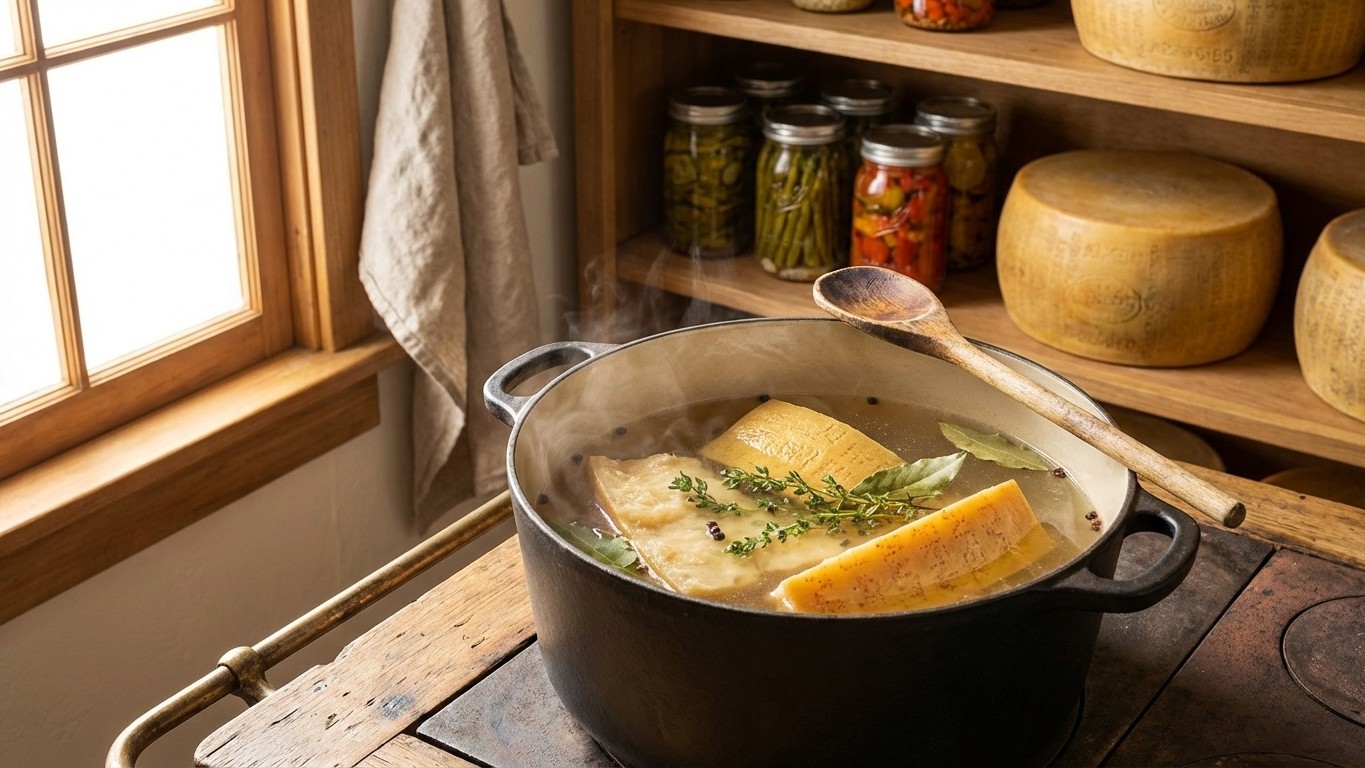
For years, I watched those gorgeous Parmesan rinds accumulate in my refrigerator, too valuable to discard yet seemingly too tough to consume. What I didn’t realize was that I was throwing away liquid gold—a centuries-old technique that turns these hardened cheese remnants into the most intensely flavored broth imaginable. This wasn’t just another modern food hack; this was an ancestral wisdom that our great-grandmothers understood instinctively in times when nothing edible ever went to waste.
The transformation began when I discovered what Italian nonnas Have Known for generations: cheese rinds impart a rich savory note, or umami, to sauces, soups, and risottos. But where many home cooks simply toss a single rind into their minestrone for a fleeting flavor boost, the real magic happens when you dedicate an Entire afternoon to extracting every ounce of concentrated cheese essence from your collected rinds.
The Forgotten Art of Nothing Wasted
Our ancestors lived by principles that virtually every religion forbids the wasting of food, and minimizing food waste is a value built into the culture of many families and communities. In an era where up to 30-40% of the food supply is wasted in the U.S. alone, this ancestral technique represents more than just clever cooking—it’s a return to the mindful resourcefulness that sustained families for generations.
The practice of transforming food scraps into nourishing broths stretches back centuries. Never ones to waste anything our ancestors found uses for everything, creating complex flavor profiles from what modern kitchens routinely discard. Historical records show that practices around food waste – how and why people wasted food, preserved it, or recycled it into new dishes and products – fluctuated over the long epoch from the early modern period to the early twentieth century, but the underlying principle remained constant: every part of the ingredient held value.
When you understand that when spending top dollar for an ingredient such as Parmigiano Reggiano, you don’t want to waste any of it, the logic becomes crystal clear. Those rinds you’ve been discarding contain concentrated umami compounds that can transform everything from a simple-rule”>simple-trick-restores-stainless-steel-shine”>Simple risotto to an elegant soup course.
The Alchemy of Transformation
Creating cheese rind broth requires patience, but the technique itself is beautifully simple. After grating your prized Parmesan over pastas and salads, save your rinds in an airtight container or zip-top bag, either in the refrigerator or freezer. Once you have roughly a cup of rinds, you’re ready to go. The key is accumulation—this isn’t an instant gratification technique, but rather a slow gathering of culinary treasure.
The transformation happens through long, gentle simmering. Start with about 8 cups of water and half a pound of cheese rinds (or whatever you have on hand). Simmer for 3-4 hours, and voila, cheese stock. During this extended cooking time, the hard rinds gradually release their concentrated flavors, creating a broth with decidedly cheesy flavor, but in a really understated way. You’ll taste a complex, subtle note beneath the rest of your components.
The beauty of this Method-doubles-your-storage-in-a-narrow-hallway”>method lies in its flexibility. You don’t need to limit yourself to Parmesan. You can use a variety of aged cheese for this broth. Parmesan Regianno, Grana Pradano, Pecorino Romano and Asiago. Each cheese contributes its own character—I love the caramel and butterscotch flavors of an aged gouda. You could also save rinds from aged provolone, cheddar or montereey.
Modern Applications for Ancient Wisdom
Once you’ve created this liquid umami, the culinary possibilities expand exponentially. Use this stock as a base for soups like Italian wedding, white bean, and minestrone. It’d be great in heartier dishes, too, like this Chicken Stew with Kale and Cannellini Beans or this Collard Greens Stew with Chorizo and Garlic. The broth becomes particularly magical when used for risotto preparation, where you can replace some or all of the chicken stock when preparing risotto, which gives you a one-two punch of cheese flavor if you finish the risotto with grated Parmigiano Reggiano.
For those seeking elegant simplicity, my favorite use for Parmesan broth may be the simplest: I love to heat the broth and float some fresh tortellini in it as an elegant first course for a winter dinner party or a light lunch. This preparation showcases the broth’s sophisticated flavor Without competition, allowing the concentrated cheese essence to shine through each spoonful.
What strikes me most about this ancestral technique is How It connects us to a time when cooking meant truly knowing your ingredients—understanding not just their primary uses, but their hidden potential. In our current age of abundance, we’ve lost touch with the kind of resourcefulness that saw opportunity in what others might discard. When you taste that first spoonful of rich, complex cheese broth made from scraps you once threw away, you’re not just experiencing better flavor—you’re reconnecting with generations of cooks who Understood that the greatest culinary treasures often hide in plain sight, waiting for someone patient enough to unlock their secrets.