
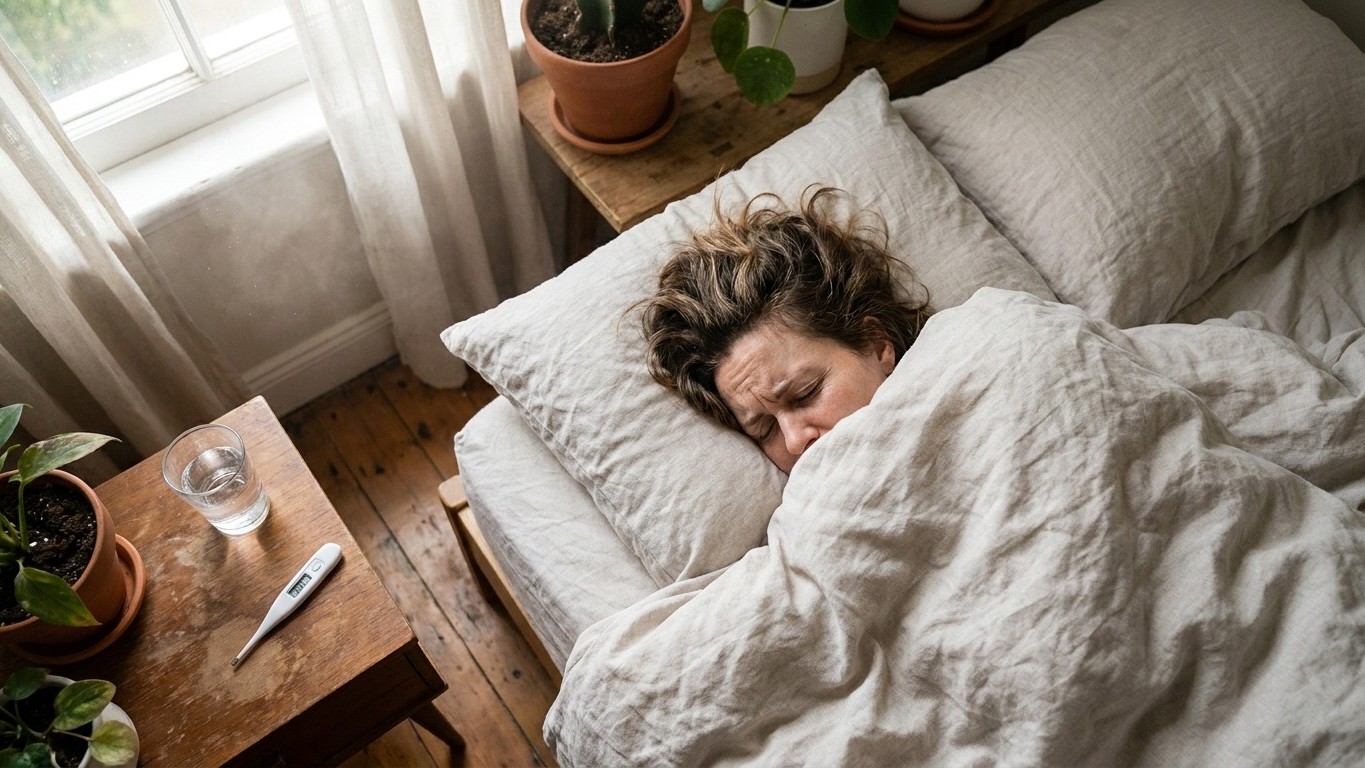
Every morning, the alarm goes off and the feeling is the same: a thick, cottony exhaustion that eight hours of horizontal time did nothing to fix. You slept. You definitely slept. The room was warm, cozy even, a reliable 28°C (82°F) because the AC felt like sleeping inside a refrigerator. Logical, right? The problem is that your body disagrees, quietly and systematically, every single night.
Here’s what actually happens when you decide that “warm and snug” is the same thing as “restful.”
Key takeaways
- Your body needs to cool down 2 degrees to enter deep sleep—a warm room blocks this entirely
- At 28°C, you’re losing 5-10% of sleep efficiency while spending the night in a semi-alert state
- The AC isn’t the problem; most people set it wrong and sabotage their own recovery
Your Body Is Trying to Cool Down, and You’re Getting in the Way
Your circadian rhythm lowers your core body temperature by as much as 2 degrees during the night. This isn’t incidental. It’s the Biological ignition switch for sleep. The drop in core body temperature correlates with circadian cycles and prompts sleepiness and melatonin production, which signals the body to prepare for sleep. The two processes are locked together: one triggers the other.
Core body temperature begins to decline before sleep onset, and the rate of this decline is predictive of sleep initiation. This pre-sleep reduction is a function of both heat dissipation and heat production, with increased heat dissipation due to skin vasodilation primarily driving the decline. In plain terms: your hands and feet act as radiators, pushing heat out through the skin so your core cools down fast enough to let you cross into deep sleep.
At 28°C, that process is fighting an uphill battle. When it’s too warm, your body struggles to cool down, which is necessary to enter the deeper stages of sleep, leading to restless nights, frequent awakenings, and less restful sleep. The exhaustion you feel in the morning isn’t mystery fatigue. It’s arithmetic.
The Sleep Stages You’re Actually Missing
Too much heat exposure is directly linked to increased wakefulness and decreased rapid eye movement (REM) sleep. “Thermoregulation is very important for staying in restorative, slow-wave sleep stages,” says one sleep medicine specialist. “These are the stages in which we get the most rest.”
In real-life situations where bedding and clothing are used, heat exposure increases wakefulness and decreases slow-wave sleep and rapid eye movement sleep. Slow-wave sleep, the deep, dreamless kind, is when tissue repair happens, when the immune system consolidates its work, when the brain files away the day’s memories. Deep sleep is when your body does its most intensive repair work: tissue recovery, immune strengthening, and memory consolidation. If your body cannot cool down effectively, these processes get compressed.
The REM loss is equally damaging. REM sleep governs emotional regulation, creative thinking, and the kind of cognitive sharpness that makes you feel like yourself at 10 a.m. When your body has difficulty cooling down, it stays in a more alert state, which for many results in increased sleep fragmentation and reduced recovery. Waking up feeling like you ran a mental marathon you don’t remember starts to make a lot of sense.
The science is blunt on the numbers. Sleep was most efficient and restful when nighttime ambient temperature ranged between 20–25°C, with a clinically relevant 5–10% drop in sleep efficiency when the temperature increased from 25°C to 30°C. A 28°C bedroom sits squarely in that degraded zone, every single night of the summer.
The AC Phobia Is Real, and It Has a Fix
Here’s where most people get stuck. The AC gets set to 18°C, it feels brutally cold within an hour, you wake up shivering and switch it off, and spend the rest of the night baking. The conclusion drawn: “I just can’t sleep with the AC on.” That conclusion is wrong, but the instinct behind it isn’t.
If your room is too hot, it can disrupt sleep. If it’s too cold, it may interfere with your ability to relax. The sweet spot is narrower than most people assume. The best room temperature for sleep is approximately 65°F (18.3°C). Most doctors recommend keeping the thermostat set between 65 to 68°F (15.6 to 20°C) for the most comfortable sleep. That’s not arctic, that’s a light sweater territory, which is exactly how your bedroom should feel when you walk in at bedtime.
The counterintuitive move: setting the AC a little warmer than you think you need, then adding or removing layers as needed. While a steamy room may seem welcoming at night, you’ll actually sleep a lot better in a cooler environment with layers of blankets or pajamas you can add or peel off as necessary. The control is in the bedding, not the thermostat alone.
There’s another tool that genuinely works, and almost no one uses it deliberately. A recent study found that warm baths taken two to three hours before bed significantly reduced the time taken to fall asleep, by around 20%. The mechanism is the same physics: the bath warms your skin, and when you step out, the rapid drop in surface temperature mimics and accelerates the core cooling your body needs to initiate sleep. You’re essentially hacking your own thermoregulation.
What to Actually Do This Summer
The goal isn’t discomfort. Nobody sleeps well while tensed against the cold. The goal is removing the thermal obstacle that’s been robbing your slow-wave and REM sleep without you realizing it. A few adjustments that work with the biology rather than against it:
- Set the AC between 18–20°C and use a lightweight cotton sheet instead of heavy bedding
- Keep curtains or blackout blinds closed during the day to prevent the room from absorbing heat before you even get in it
- Take a warm shower 60–90 minutes before bed to trigger the temperature-drop response
- Use a fan even with AC, moving air accelerates surface cooling without requiring the room to be colder
As the body is busy managing and adjusting its temperature, which requires more effort when temperatures soar, there is a higher likelihood that sleep will be disturbed, because the additional methods of cooling are associated with sympathetic nervous system activity, your body’s fight-or-flight response. Sleeping hot, keeps your nervous system slightly activated all night. That’s the physiological reason you wake up feeling wound rather than rested, not a mystery, not stress, not your mattress. Temperature.
One thing worth knowing before you touch that thermostat tonight: the body’s need to cool down before sleep is so deeply wired that researchers are now developing mattresses with real-time temperature adjustment systems that shift dynamically across sleep stages. Thermoregulation plays a pivotal role in sleep quality, as the body’s ability to regulate temperature varies across different sleep stages. The science has moved far past “keep it cool.” The next frontier is a bed that thinks ahead of your body’s own cycles, adjusting before you even shift from light to deep sleep. For now, though, 19°C and a light blanket will do more for your mornings than any supplement on the market.
Sources : pmc.ncbi.nlm.nih.gov | superpower.com