
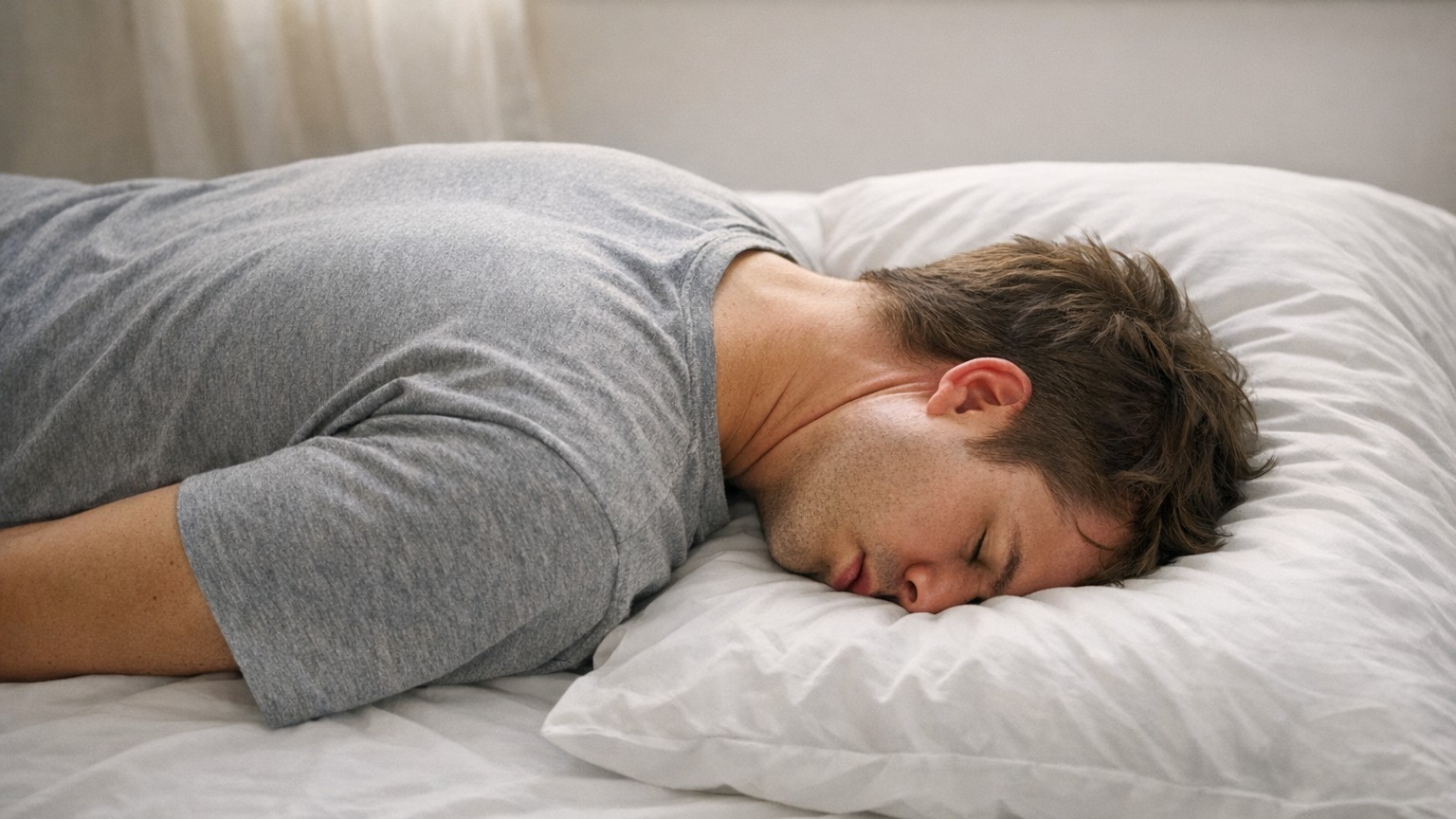
Every morning, same ritual: eyes open, neck locked, the slow, grimacing rotation to face the ceiling. Harmless, you tell yourself. Just how you sleep. Except that eight hours of face-down rest is doing something to your spine that no amount of morning coffee fixes, and a physio visit, one unremarkable Tuesday, changes the way you understand what happens to your body between midnight and 6 a.m.
Key takeaways
- Stomach sleeping rotates your neck 90 degrees for 7+ hours—equivalent to holding that position with mounting pain all night
- The strain doesn’t stop at your neck; it hyperextends your lower back through a biomechanical cascade most people never suspect
- A thin pillow under your pelvis and switching to side or back sleeping can eliminate years of accumulated spinal damage in 2-6 months
What Your Neck Is Actually Doing While You Sleep
When you sleep on your stomach, you must turn your head to one side in order to breathe, which means twisting your neck, moving it out of alignment with the rest of your spine. That part, most people already know, vaguely. What they don’t picture is the duration. A quick test makes it real: stomach sleeping forces your neck into a rotated position for hours. Turn your head 90 degrees to the left and hold it there. After 30 seconds, your neck starts to ache. Now imagine holding that position for 7 hours — that is what stomach sleeping does every night.
The structural consequences go further than muscle soreness. Sleeping on your stomach puts significant strain on the neck, particularly the C1-C2 vertebrae, the top two bones of your cervical spine, responsible for most of your head’s rotation. The strain and stress placed on the neck by sleeping with this near-90-degree rotation continues for many hours at a time. That cervical strain in turn causes hyperextension of the lumbar spine. So what starts as a neck problem cascades south, loading the lower back through the entire night.
The research backs this chain reaction. An epidemiological study examining waking cervical symptoms and sleep posture found that participants who reported prone as their dominant sleep posture also reported the highest percentage of waking cervical symptoms. That morning stiffness is not bad luck or aging. It is physics.
The Cascade Nobody Mentions: From Neck to Lower Back
Sleeping on your stomach is the worst position for your spine, according to spine surgeon Dr. Raymond J. Hah of Keck Medicine of USC. “This position puts the most pressure on your spine’s muscles and joints because it flattens the natural curve of your spine.” That flattening has a very specific mechanism. Your torso naturally sinks deeper into the mattress because of its weight. As a result, your back arches, stretching your spine out of neutral alignment.
Stomach sleeping places the lower back in an unnatural arch that puts pressure on spinal joints and ligaments throughout the night. This sustained hyperextension can exacerbate existing disc problems and create morning stiffness. For people who already spend their days hunched over a laptop or standing in heels, this is not a neutral starting point. As one chiropractor puts it: “It puts added stress on your lower back, and that’s a part of the body that most of us are already taxing in our day-to-day activities. Stomach sleeping doesn’t give those muscles a chance to rest and recover.”
There is a counterintuitive footnote here worth sitting with: people assume stomach sleeping is instantly damaging. But occasional prone sleeping does not automatically cause injury, poor support and prolonged strain do. A single night face-down will not ruin your cervical spine. Years of it, compounded by a too-soft mattress, no pelvic support, and the same rotated direction every night? That is a different conversation entirely.
There is also one legitimate upside that nobody wants to give up: sleeping on your stomach can reduce snoring and diminish sleep apnea, which is why many people cling to it despite the pain. The position keeps the airway open. The body, in its pragmatic wisdom, trades spinal integrity for oxygen. Hard to argue with that logic at 2 a.m.
What Physios Actually Recommend (And the Pillow Strategy That Works)
Back sleeping is considered the best sleeping position for neck pain, because it helps keep your spine in a neutral position, which minimizes strain on your neck muscles. Side sleeping is the practical second choice for those who find the back too unfamiliar. If you sleep on your side, draw your legs up slightly toward your chest and put a pillow between your legs, flexing your knees and having a pillow between your legs helps align your spine, pelvis and hips, taking pressure off your spine.
If you cannot face abandoning the stomach position entirely, try sleeping with a very thin pillow beneath your head, or no pillow at all. The thicker your pillow, the more strain your neck experiences, since it forces the neck to angle upward. When your head lies directly on the mattress surface, your head and neck are more likely to remain aligned with your spine. Add to that: to further align your spine, place a thin pillow beneath your pelvis, positioned between your lower abdomen and mid-thigh. That single addition reduces the lumbar arch dramatically.
For those ready to make the switch for real, patience is the operative word. The transition may take 2 to 6 months, but the benefits, like better posture and reduced neck pain, make it worthwhile. Side sleeping works well as an intermediary step before fully transitioning to back sleeping. Place a body pillow along your front so rolling onto your stomach becomes physically awkward. It sounds low-tech. It works.
One more thing the mattress industry prefers you not know: most mattresses that suit stomach sleeping are firm, because firm surfaces prevent the hips from sinking. But that same firm mattress is uncomfortable for side sleeping because it doesn’t cushion the shoulder and hip. If you switch to side sleeping on a mattress that is too firm, your shoulder and hip will ache, and you will unconsciously roll back onto your stomach for relief. The position change fails not because of habit, but because of discomfort.
As we age, spinal discs lose hydration and joints become less forgiving, making spine alignment during sleep progressively more important. Which means the conversation you have with your physio at 35 carries more weight than the one you would have had at 22, when the body absorbed everything/”>Everything and asked no questions. The neck that woke you up stiff this morning has been rotating, compressing, and quietly accumulating strain for years. The morning it finally talks back loudly enough, that is usually the morning something actually changes.
Sources : journals.plos.org | keckmedicine.org