
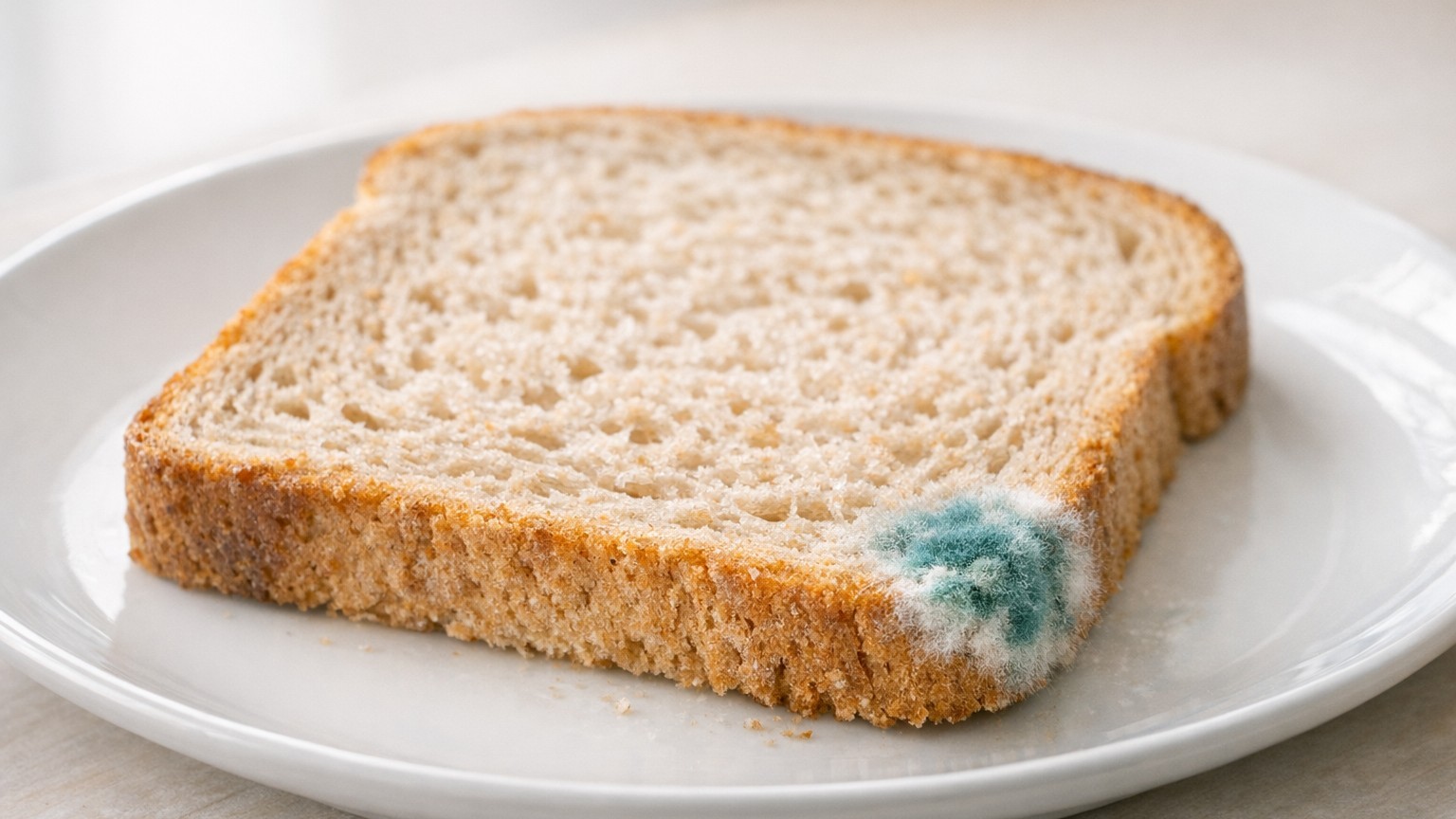
A small blue-green patch on a corner of the loaf. You hesitate for a second, grab a knife, cut it off, and move on. Rational, practical, waste-conscious, and, it turns out, wrong. Not mildly wrong. Structurally, scientifically, unambiguously wrong. Food safety experts have been saying this for years, and the evidence behind it is more nuanced than a simple “throw it all out” headline suggests.
Key takeaways
- The fuzzy mold you see is just the tip—invisible root threads have already invaded deep into the bread’s interior
- Mycotoxins, toxic chemicals produced by mold, can resist heat and spread unevenly through the loaf
- One simple storage shift can prevent moldy bread before it ever becomes a problem
What You See Is Not What You Get
The mold you see on the surface of food is only a fraction of what’s actually there. When food shows heavy mold growth, “root” threads have already invaded it deeply. With bread, the situation is particularly deceptive. Mold is a type of fungus that thrives in moist, warm environments, and bread is the perfect breeding ground. Once mold spores land on a loaf, they begin spreading microscopic roots through the interior, feeding on starch and moisture. The fuzzy spot you trim off? That’s the reproductive structure. The real organism is already inside.
Bread is a soft, airy, porous food. Like the roots of a weed spreading beneath loose soil, mold sends invisible structures called hyphae deep into the loaf. What you see is only the “flower”, but the web of contamination reaches much farther. This is what food scientists mean when they talk about bread being uniquely vulnerable: its open crumb structure acts as a highway for fungal penetration, not a barrier.
Marianne Gravely, a food safety expert with the USDA, notes that cutting mold off bread is simply not recommended because the texture is too soft to guarantee the mold has not spread. The only safe action is to discard the entire loaf. This is the official position. Full stop.
The Cheese Loophole (and Why Bread Doesn’t Get One)
Here’s where most people trip up, and frankly, the confusion is understandable. We’ve all heard that you can cut the mold off a block of cheddar and keep going. That’s true, but it only works because of a structural reality that bread simply doesn’t share.
The safety rule depends on the food’s structure. Hard cheeses have a tight, dense texture and low moisture, making it difficult for mold to spread far beyond what you see. That’s why cutting at least 2.5 centimeters (1 inch) around the mold is safe for cheeses like cheddar or Swiss. Bread and soft baked goods are the opposite: their porous, moist structure acts like a sponge, letting mold roots penetrate deeply and quickly. The USDA and food scientists agree: for bread, spotting any mold means tossing the entire product.
The cheese exception applies only to the whole block format. Even hard cheeses should be tossed if they’re shredded or sliced, as these processes negate the mold buffer that a substantial block of hard cheese provides. Once the dense structure is broken, you’re back in bread territory. Same logic, same risk.
Mycotoxins: The Part You Can’t Toast Away
Beyond the physical spread of mold threads lies a second problem that most people don’t think about: chemical contamination. Molds can produce mycotoxins, which are toxic compounds that cause nausea, diarrhea, or allergic reactions. These aren’t living organisms you can kill with a toaster, they’re stable chemical byproducts that linger in the food long after any heat exposure.
Some molds commonly found on bread, like Aspergillus, Penicillium, or Rhizopus species, produce dangerous chemicals called mycotoxins. These toxins can cause everything from stomach upset to long-term health problems, and they are heat-resistant. Even after toasting or baking, mycotoxins can remain in the food, still capable of causing illness.
A 2024 peer-reviewed study published in Food Chemistry adds a precise and somewhat surprising layer to this picture. Researchers inoculated five types of bread with common mold species and analyzed metabolite profiles in and around the mold spot, as well as at a lateral distance of 3 cm. Most metabolites were concentrated in and directly below the inoculation area, with one critical exception: citrinin, a mycotoxin produced by certain Penicillium strains, was detected in almost all tested bread areas. The findings suggest that most mycotoxins don’t spread uniformly across the loaf, but citrinin behaves differently and can travel broadly. The study’s authors suggest that removing moldy parts might be a solution to reduce food waste if the remaining bread is used for insect farming to produce animal feed — not for human consumption. A meaningful distinction.
People with asthma, weakened immune systems, or mold sensitivities may experience more serious effects, including respiratory irritation or infection. And certain mycotoxins have been linked to liver or kidney damage after long-term, high-level intake, which is why food agencies recommend a strict “when in doubt, throw it out” approach.
How to Store Bread So the Question Never Comes Up
The real win here isn’t knowing when to throw bread away, it’s keeping it out of the danger zone in the first place. Storage is where most households go wrong, often with the best intentions.
Plastic bags at room temperature create the worst combination: warm, moist, and sealed. Plastic traps moisture released by bread as it cools and ages. That moisture condenses on the surface, creating the perfect environment for mold spores to grow, which is why bread in plastic often molds before it even goes stale. The intuitive storage choice is frequently the most damaging one.
For everyday use, a bread box with proper ventilation is worth the investment. For longer preservation, freeze sliced bread in airtight containers or freezer bags, where it can last up to 3 months. Avoid refrigeration, as it actually accelerates staling. The freezer-to-toaster method, often dismissed as a compromise, is actually the cleanest option for anyone who doesn’t finish a loaf within three or four days.
Store-bought bread typically contains preservatives that help fight off mold, but artisanal and homemade varieties are particularly vulnerable due to their lack of preservatives. As synthetic preservatives fall out of favor, more natural solutions such as fermentation-based approaches are gaining traction, using fermented flours and sourdoughs to naturally lower pH and introduce organic acids that inhibit mold. That long-fermented sourdough from your local bakery isn’t just tastier; its acid profile gives it a meaningful head start against fungal growth.
One more detail worth knowing, especially if you store bread in a box or bin: mold spores from affected food can build up in your refrigerator, dishcloths, and other cleaning utensils. The container that held the moldy loaf becomes a source of re-contamination for the next one. A quick wipe-down with a diluted solution between loaves isn’t fussiness, it’s the step that closes the loop.
Sources : today.com | bargainboxed.com