
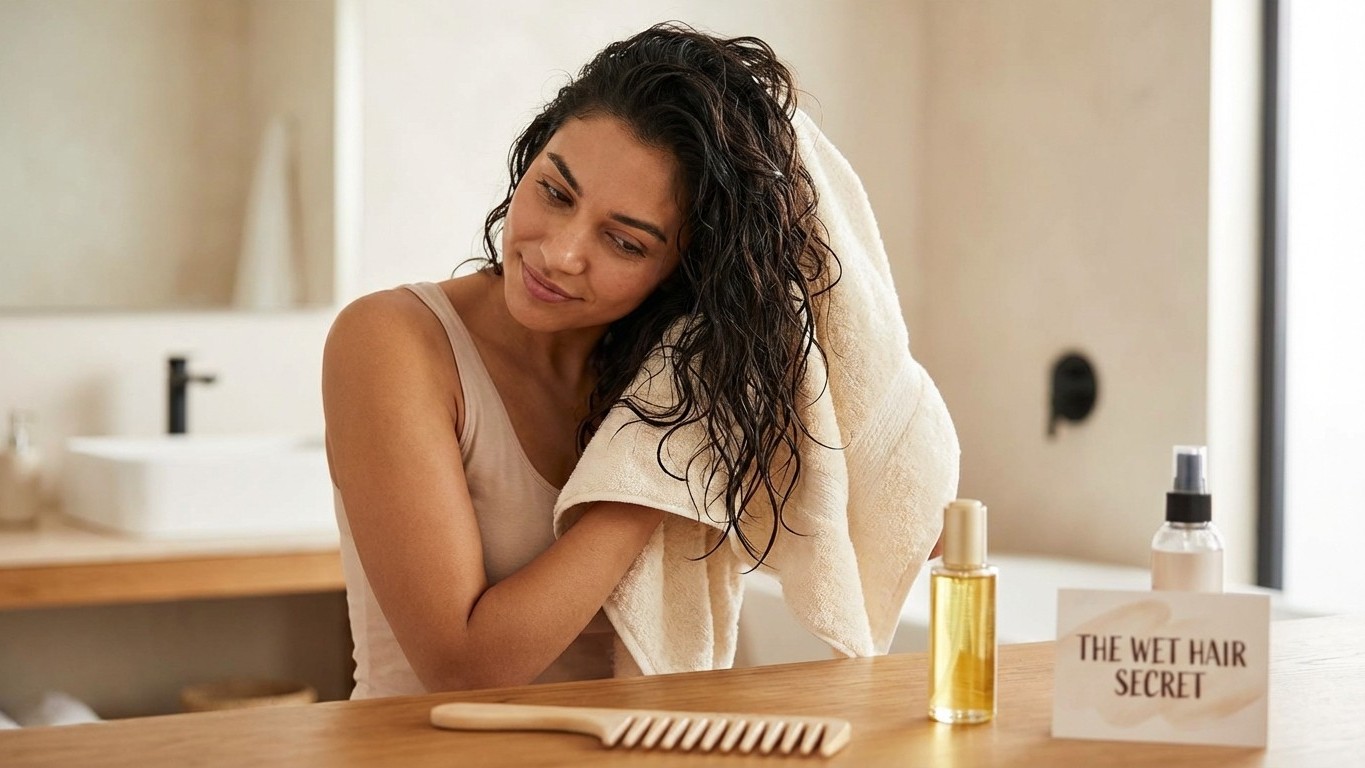
Picture this: you step out of the shower, grab your trusty brush, and start working through those tangled wet strands. Sound familiar? If you’re nodding along, you’re not alone – but you might be unknowingly sabotaging your hair’s health with every stroke. The revelation came to me during a conversation with celebrity hairstylist Maria Rodriguez, who casually mentioned that she never brushes wet hair. “It’s one of the biggest mistakes I see clients make,” she explained. That simple statement sparked a complete transformation in my hair care routine, and the results have been nothing short of extraordinary.
The Science behind this game-changing approach is surprisingly straightforward yet profound. When your hair is wet, the hydrogen bonds that give your strands their strength are temporarily weakened. Think of wet hair as being in its most vulnerable state – the hair shaft swells with water, Making-my-bed-was-healthy-until-allergists-revealed-this-Morning-mistake”>Making-a-major-comeback-in-every-outfit”>Making it up to three times more elastic than when dry. This elasticity might seem beneficial, but it’s actually your hair’s Achilles’ heel. Every brush stroke on wet hair creates micro-tears in the cuticle, leading to frizz, breakage, and long-term damage that accumulates over months and years.
The hidden Damage You’re Creating
Professional trichologist Dr. Sarah Chen explains that wet hair breakage isn’t immediately visible, which makes it particularly insidious. “Clients come to me wondering why their hair feels thinner, looks duller, or won’t grow past a certain length,” she notes. “Often, the culprit is mechanical damage from brushing wet hair.” The damage manifests in multiple ways: split ends that travel up the hair shaft, weakened protein bonds that reduce overall hair strength, and disrupted cuticles that leave hair vulnerable to environmental stressors.
The impact goes beyond mere aesthetics. When you repeatedly brush wet hair, you’re essentially training your strands to break at their weakest points. Over time, this creates an uneven texture where some sections remain healthy while others become progressively more damaged. This inconsistency is often mistaken for natural hair variations, leading people to believe they simply have “difficult” hair when the real issue lies in their brushing technique.
The Professional Approach That Actually works
So what’s the alternative? The professional approach involves a complete mindset shift about post-shower hair care. Instead of reaching for a brush, start with a wide-tooth comb or, even Better, your fingers. Begin at the ends and work your way up, gently separating tangled sections rather than forcing them apart. This technique, known as “sectional detangling,” is standard practice in high-end salons because it preserves the hair’s integrity while effectively removing knots.
The timing of your detangling matters just as much as the technique. Professional colorist James Morrison recommends applying a leave-in conditioner or detangling spray before any manipulation. “The product creates slip between the strands, reducing friction and making the process gentler,” he explains. Some stylists-check-first-that-changes-everything”>changes-everything”>stylists even advocate for detangling in the shower while conditioner is still in the hair, using the product’s lubricating properties to ease the process.
For those with curly or textured hair, this approach is even more critical. Celebrity curl specialist Nina Thompson emphasizes that wet brushing can completely disrupt the curl pattern, leading to frizz that lasts for days. “Curly hair has natural weak points where the curl bends,” she notes. “Wet brushing targets these exact vulnerable spots.” Instead, she recommends scrunching excess water out with a microfiber towel and allowing the hair to air dry into its natural pattern before any Styling manipulation.
Transforming Your Daily Routine
Making this transition requires patience and a willingness to relearn your morning routine. The first week might feel awkward as you resist the urge to grab your brush immediately after showering. Start by wrapping your hair in a microfiber towel or cotton t-shirt to gently absorb excess moisture Without creating friction. This “plopping” technique, popular among curl enthusiasts, Works for all hair types and significantly reduces drying time while maintaining hair health.
The real magic happens in the weeks that follow. As you eliminate daily wet brushing damage, your hair begins to recover its natural strength and shine. Many people report that their hair feels thicker, looks glossier, and styles more easily. The improvement is gradual but unmistakable – like watching your hair slowly return to its healthiest state.
Beyond the immediate benefits, this approach opens up new styling possibilities. When your hair isn’t constantly battling damage, it responds better to styling products and holds styles longer. Professional-grade results become achievable at home because you’re working with healthier hair as your foundation. The transformation extends to color retention as well, since undamaged cuticles hold pigment more effectively, keeping your color vibrant longer.
This Simple change – refusing to brush wet hair – represents a fundamental shift toward treating your hair with the Same care professionals provide in salons. It’s a small adjustment that yields disproportionately large results, proving that sometimes the most powerful Beauty secrets are also the simplest. Your hair deserves this level of consideration, and the daily choice to skip the wet brush is an investment in Years of healthier, more beautiful hair ahead.