
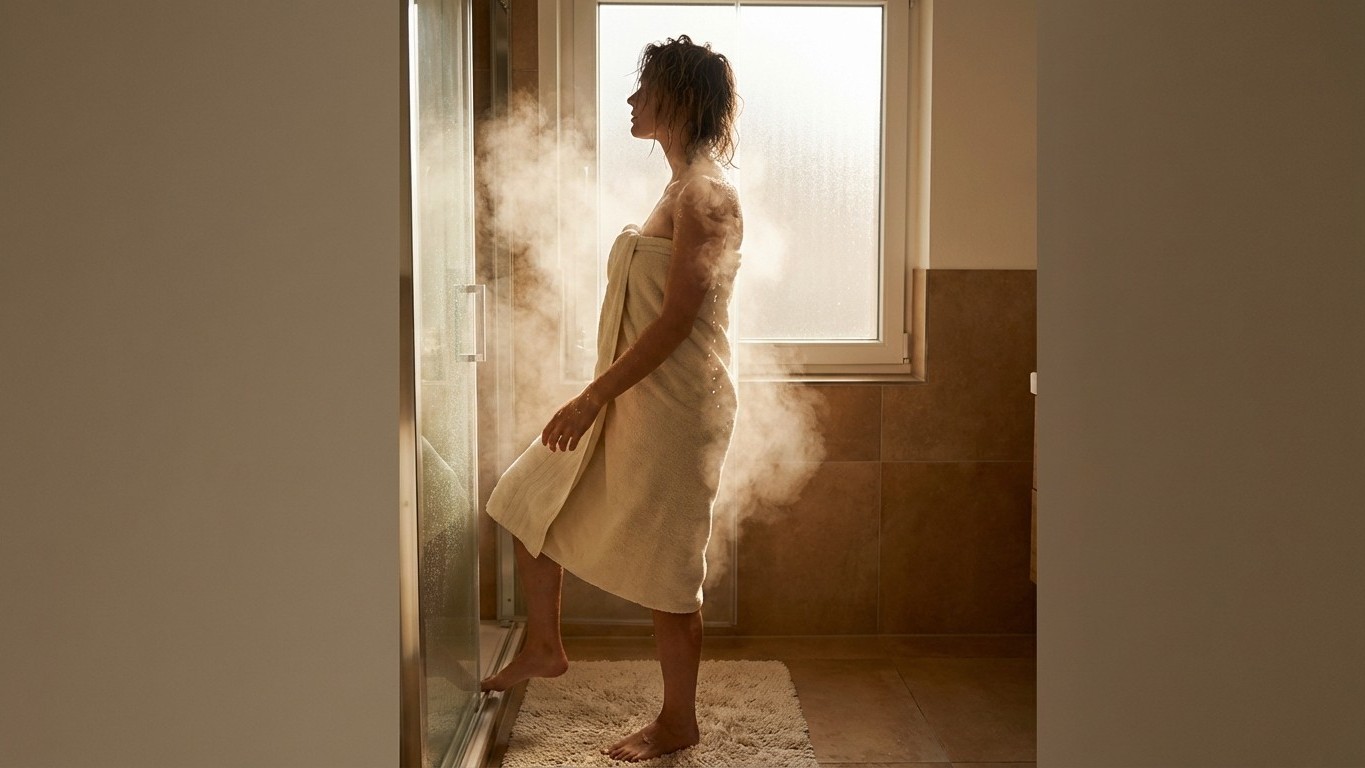
Picture it: you’ve just scrolled through a dozen sleep optimization threads, bought a fan, downloaded a white noise app, turned the thermostat down to 67°F, and you’re still lying there at midnight, staring at the ceiling. Every sleep doctor you’ve consulted says the same thing: keep your bedroom cool, dark, and quiet. Good advice, technically. Not wrong. But it’s also incomplete, and that gap matters more than most people realize.
The counterintuitive fix that no one leads with? A hot shower, taken at the right time, at the right temperature, can do something a perfectly calibrated thermostat simply cannot.
Key takeaways
- Every sleep doctor recommends a cool room, but they’re missing the mechanism that actually makes you fall asleep
- A hot shower creates a rapid core temperature drop that mimics and amplifies your brain’s natural sleep signal
- Research shows this simple ritual reduces the time to fall asleep by 36%—comparable to many sleep medications
The Real Science Behind Sleep and Temperature
Core body temperature cycles alongside the sleep-wake rhythm, decreasing during the nocturnal sleep phase and increasing during the wake phase, and sleep is most likely to occur when core temperature decreases. That part, doctors get right. Where the standard advice oversimplifies is in assuming you can only influence that process from the outside, by cooling the room around you.
The evening drop in core body temperature isn’t just a side effect of getting sleepy, it’s actually one of the primary mechanisms that makes you sleepy. This is why a warm bath or shower before bed can be so effective: it initially raises your skin temperature, but when you get out, the rapid cooling mimics and amplifies that natural process.
The mechanism is surprisingly elegant. The warmth of the bath or shower opens blood vessels, bringing a large blood flow to the surface of the body, especially in the hands and feet. “More blood flows out from the core, so heat is easily lost to the environment.” Your body temperature spikes, then falls fast. And that fall is the signal your brain has been waiting for. Your body cooling down after a warm shower “is conducive to melatonin release.”
What the Research Actually Shows
This isn’t wellness folklore. A systematic review and meta-analysis examined 17 studies involving over 500 participants and found consistent evidence that passive body heating before bedtime improves multiple sleep parameters. The numbers are hard to ignore.
Warm water immersion at 40–42.5°C (104–108.5°F) for 10–15 minutes reduces sleep onset latency by an average of 36%, and the optimal timing is 90 minutes before desired bedtime, allowing the body’s natural cooling response to align with circadian sleep signals. Thirty-six percent. For a ten-minute shower. No prescription required.
That 36% reduction in sleep onset time is clinically meaningful and comparable to many sleep medications, but without side effects. And yet somehow it remains a footnote in most conversations about sleep hygiene, buried under mattress toppers and blackout curtain recommendations.
Research from the Journal of Physiological Anthropology added another layer of nuance: the fall in sublingual temperature from after bathing to before sleep was significantly larger with longer bathing, and sleep onset latency by actimeter was significantly reduced with longer bathing compared to showering alone. the bigger the temperature swing you create, the stronger the sleep signal.
The Paradox Your Thermostat Can’t Solve
Here’s where the received wisdom gets complicated. Optimal sleep occurs in cool environments (65–68°F ambient temperature) that allow efficient heat dissipation. Rooms that are too warm (above 75°F) can significantly impair sleep quality by interfering with natural cooling processes. So yes, a cool room helps. It creates the right conditions for your body to shed heat. But it doesn’t initiate the process. It just waits for your body to do the work on its own schedule.
A hot shower, on the other hand, hijacks the timeline. It forces rapid vasodilation, floods the skin’s surface with warm blood, then creates a steep drop the moment you step into cooler air. Sleep onset and a reduction in core temperature occur together. Non-rapid eye movement (NREM) sleep episodes are also accompanied by core and brain cooling. The shower accelerates that cascade artificially, and your brain responds as though it were entirely natural, because physiologically, the signal is identical.
A meta-analysis of studies revealed that heat loss, indirectly measured by the distal-proximal skin temperature gradient, was the best predictor variable for sleep onset latency, outperforming even core body temperature, heart rate, melatonin onset, and subjective sleepiness ratings. You can feel exhausted and still not fall asleep quickly. But engineer that heat-loss gradient properly, and the door opens.
How to Actually Do This
Precision matters here. Water temperature of 40–42.5°C was associated with both improved self-rated sleep quality and sleep efficiency, and when scheduled 1–2 hours before bedtime for as little as 10 minutes, significant shortening of sleep onset latency was observed. Too hot and you risk overstimulating your system; too cool and you won’t trigger the vasodilation response. Think: comfortably warm, not punishing.
Timing is the other variable people get wrong. Jump straight from the shower to bed and you’re defeating the purpose, your core temperature is still elevated, your skin still radiating. The timing is key: 90 minutes before bed allows enough time for this cooling response to occur. That window is where the magic happens. Use it to wind down — dim light, a book, something that doesn’t require a decision. The shower already did the heavy lifting.
Both baths and showers are effective, though baths showed slightly larger effect sizes, possibly due to greater body surface area exposure to warm water. If a full bath is accessible to you a few nights a week, it’s worth the extra ten minutes. But a shower, the thing most of us already do daily, is more than sufficient. The ritual doesn’t have to be complicated to work.
One more thing worth knowing: passive body heating before bedtime shortens sleep onset latency and increases slow-wave sleep and non-rapid eye movement sleep consolidation, an effect that may be particularly beneficial for older adults, given the sleep-related changes associated with aging. So this isn’t just for the chronically stressed millennial who can’t quiet her racing thoughts. It scales across life stages, stress levels, and sleep challenges.
A cool bedroom and a hot shower aren’t competing strategies. They’re two halves of the same physiological argument, one sets the stage, the other fires the opening act. The real question is why, after all this research, the shower half is still the one nobody’s talking about at your next checkup.
Sources : jcsm.aasm.org | pubmed.ncbi.nlm.nih.gov