
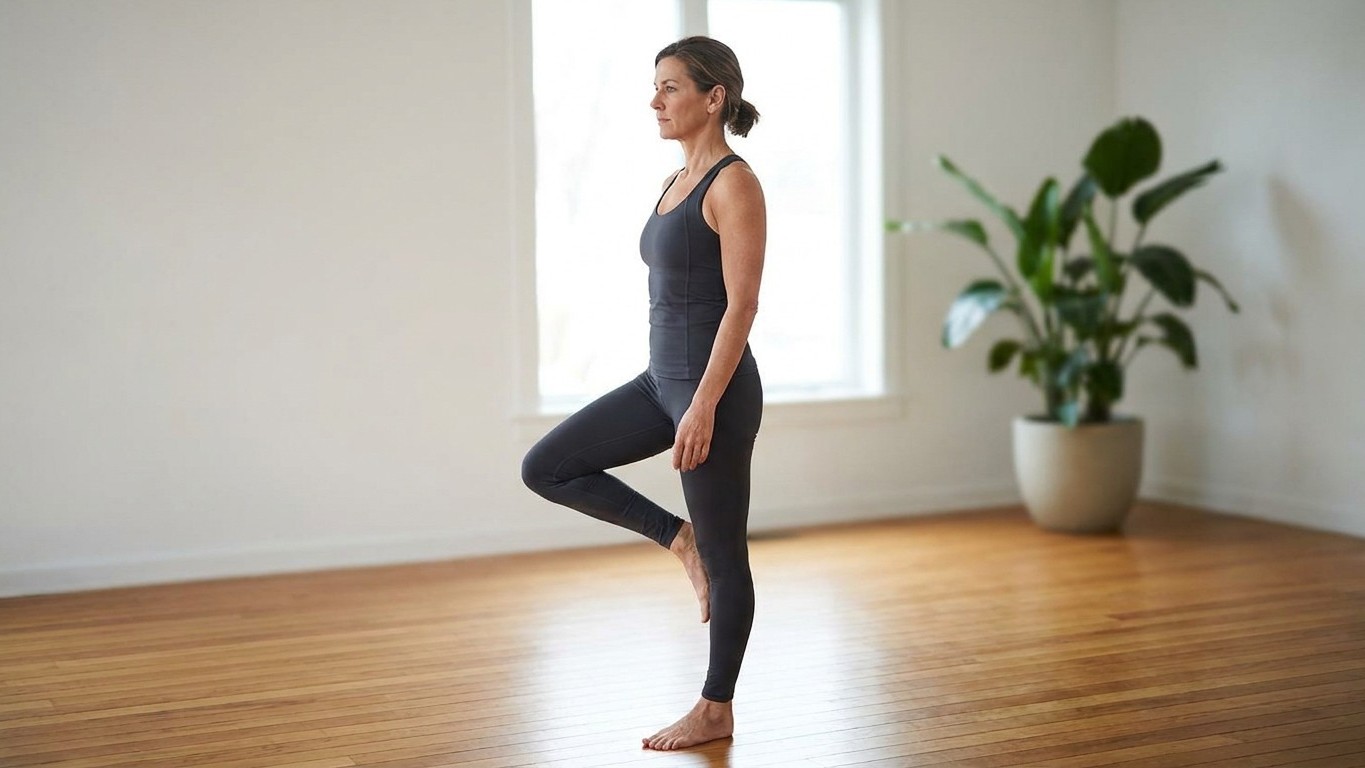
Ten seconds. That’s all it takes. Stand on one foot, arms at your sides, eyes open, and count. If you wobble, grab the wall, or put your foot down before you reach ten, that moment is telling you something your annual checkup probably never mentioned.
At 53, failing this test doesn’t feel dramatic. It feels like nothing. A minor inconvenience, a laughable party trick gone wrong. But the research behind it is anything but trivial. The inability to stand on one leg for 10 seconds in mid to later life is linked to a near doubling in the risk of death from any cause within the next 10 years, according to research published in the British Journal of Sports Medicine. Not from falls specifically. From any cause.
The number that stopped me cold: those who couldn’t hold a single leg stance for 10 seconds had an 84% higher risk of dying from any cause within the following decade, and among those who failed the test, 17.5% died during follow-up, compared to just 4.6% of those who passed. That asymmetry is what changes the conversation entirely.
Key takeaways
- A simple 10-second balance test predicts mortality risk better than most health markers—and most doctors aren’t checking it
- Your balance decline reveals an invisible convergence of aging systems: vision, inner ear, neurons, and proprioception all failing in parallel
- Balance training shows unusual speed improvements—tai chi users improved their one-leg stance by 61% in just 12 weeks
What Balance Actually Reveals About Your Body
Here’s the counterintuitive part. The test isn’t measuring your balance. Not really. Balance is just the output, the visible symptom of a dozen invisible systems working (or failing to work) in concert. Sensory inputs relevant to balance reach the central nervous system from the visual, vestibular, and proprioceptive apparatus. After age 50, vision begins to deteriorate, with progressive decline in acuity, depth perception, contrast sensitivity, accommodation, and dark adaptation.
Then there’s what’s happening in the inner ear and the nervous system itself. Neurons in the vestibular nuclei are lost at a rate of about 3% per decade after age 40. You don’t feel that loss happening. The gradual loss of vestibular nerve endings with aging can result in balance problems without any associated dizziness, this type of slow loss may be first noticed as difficulty walking or standing, especially in the dark while on soft or uneven surfaces.
Normal aging is associated with slower cognitive processing, slower postural reactions, and decreased muscle strength, all of which are essential for optimal proprioception and balance, and age-related proprioception issues typically begin to present themselves in persons 50 or older. So when you wobble at 53, your body isn’t being clumsy. It’s showing you a convergence of systems quietly degrading in parallel.
A 2024 Mayo Clinic study delivered a striking finding: single leg balance is the single best indicator of neuromuscular aging, declining faster than grip strength, walking speed, or knee extension force. Faster than grip strength. That detail alone upends every assumption about what fitness markers we should prioritize after 50.
The Health Cluster Nobody Talks About
What makes the 10-second test genuinely useful as a clinical signal isn’t the balance itself, it’s what tends to cluster around it. Those who struggled with single-leg static balance reported more health conditions, including hypertension, dyslipidemia, obesity, coronary artery disease, and, most diabetes mellitus. The test, functions as a kind of proxy — a quick physical snapshot of overall metabolic and cardiovascular health that no blood pressure cuff can capture in 60 seconds.
Unlike aerobic fitness, flexibility, and muscle strength, balance tends to be preserved until the sixth decade of life, after which it wanes precipitously. This is actually the most important sentence in this entire body of research. Because it means that struggling to balance at 53 isn’t a normal part of aging you should quietly accept. It’s an early signal, arriving at exactly the right moment to act on it.
In the landmark study, after a median of 7 years, 123 people died due to cancer (32%), cardiovascular disease (30%), respiratory disease (9%), and COVID-19 (7%). The causes of death weren’t balance-related. The balance test was reflecting the body’s overall biological state, and that state has a trajectory.
What Actually Changes When You Train for It
The good news, and there genuinely is good news, is that balance responds to training with unusual speed. A systematic review of balance training studies found significant improvements in adults over 65, with some studies showing 20-40% improvement in single leg stance times after 8-12 weeks of targeted practice.
Tai chi, in particular, has accumulated an unusually strong evidence base. Participants in a Taijiquan group improved their one-leg stand by 61% after 12 weeks of practice. That’s not a marginal improvement. For reference, tai chi has the strongest evidence among balance interventions, reducing fall risk by 43% in older adults.
The mechanism behind exercise-driven improvements goes deeper than muscle strength. Exercise mitigates the consequences of age-related proprioceptive and vestibular decline, with documented improvements in balance, body posture, and gait. The nervous system, it turns out, retains a surprising capacity for adaptation, what researchers call neuroplasticity in the vestibular and proprioceptive circuits. Exercise makes a strong case for exercise-based interventions in elderly individuals to improve balance, and it mitigates the consequences of aging-linked neuronal and muscular decline, including improvements in balance, body posture, and gait.
Practically speaking: the World Health Organization recommends older adults perform activities that stimulate balance and mobility at least three days per week to reduce their risk of falling. Starting is simpler than most people think. Standing on one leg while brushing your teeth. Doing calf raises on a folded towel to introduce instability. Progressing from eyes open to eyes closed as confidence builds. For added challenge, balancing on one leg while standing on a pillow introduces an unstable surface that accelerates neuromuscular adaptation.
The honest framing here matters. This is an observational study, it cannot establish cause. Failing the 10-second test doesn’t doom you, and passing it isn’t a clean bill of health. But the test “provides rapid and objective feedback for the patient and health professionals regarding static balance” and “adds useful information regarding mortality risk in middle-aged and older men and women.” That’s what your doctor should be asking you to do, right alongside checking your blood pressure, and most aren’t.
What’s worth sitting with is this: balance on your non-dominant leg drops by approximately 2.2 seconds per decade, making it the most age-sensitive physical metric researchers have measured. Which means the window between “this is fine” and “this is a problem” closes faster than anyone expects, and the 10 seconds you can’t hold today is worth far more attention than the number on your scale.
Sources : onlinelibrary.wiley.com | tandfonline.com