
The chlorine is doing its job. That’s what most contact lens wearers tell themselves as they dive into the pool, lenses firmly in place, vision sharp, no goggles required. A reasonable assumption. A wrong one.
The moment your soft contact lenses hit pool water, something quietly alarming begins. Contact lenses can absorb potentially harmful microorganisms present in swimming pools, lakes, rivers, or oceans. The chemistry behind it is almost elegant in a horrible way: soft lenses are made of either plastic hydrogels or silicone hydrogels, both of which are designed to absorb water to retain moisture and flexibility. That same quality that makes them comfortable to wear for 12 hours straight turns them into a microscopic sponge for whatever is floating in that water. The porous nature of hydrogels makes them more prone to contamination.
Key takeaways
- Soft contact lenses absorb pool water like a sponge, trapping harmful organisms against your eye
- Acanthamoeba, a parasite found in all water sources, causes infections in 30% of contact lens wearers who swim
- One patient lost vision in her eye after a beach trip; treatment can last 12 months or lead to blindness
Meet the organism your optician will never let you forget
Chlorine kills a lot of things. Not Everything. According to optometrist Timothy Gibbons of the John A. Moran Eye Center, “It doesn’t matter if it’s freshwater or a chlorinated pool, there are bugs and pathogens that chlorine doesn’t kill, which could potentially cause damage to the cornea, infection, or ulcers.” The most terrifying example is a single-celled organism called Acanthamoeba.
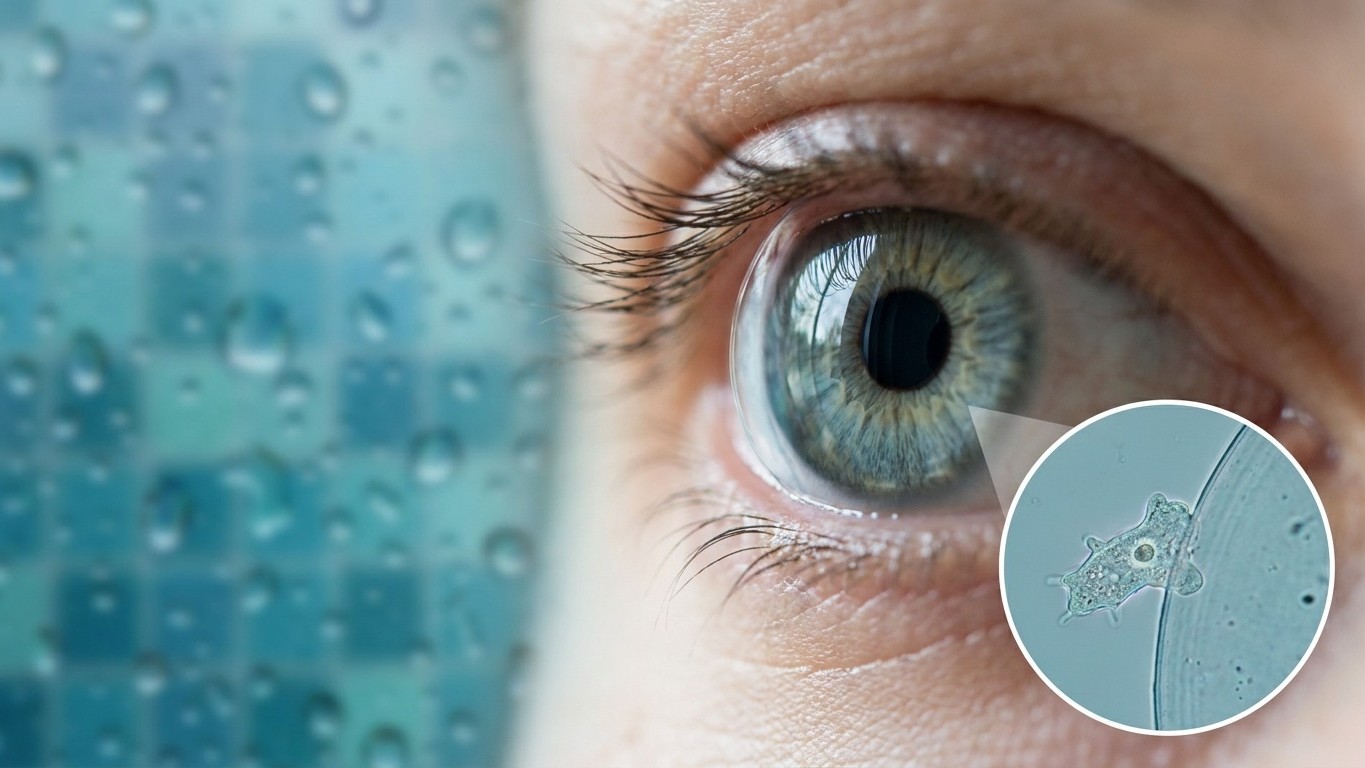
Acanthamoeba are single-celled organisms found in pools, hot tubs, tap water and shower water, according to the American Academy of Ophthalmology. They’re everywhere, and under normal circumstances, they wash off the eye harmlessly. The problem starts when contact lenses are involved. Soft contact lenses can act like a sponge, absorbing water and impurities such as Acanthamoeba, and becoming their portal of entry into the cornea. Contact lenses can also create tiny cuts on the eye that make it easier for the parasite to enter as they become trapped under the lens. That’s the detail your optician shows you when they pull up the imaging: a microscopic organism that used your lens as a vehicle, then started tunneling into corneal tissue.
The resulting condition, Acanthamoeba keratitis, is not a mild inconvenience. It is rare in the U.S., but when it does strike, it most often affects contact lens wearers. Contact lens wearers make up at least 90% of AK cases. And statistically, studies show that 30 percent of contact lens wearers who develop Acanthamoeba keratitis have gone swimming in their contact lenses. One in three cases. From a habit most people consider totally harmless.
What it actually feels like, and why it’s so hard to treat
The symptoms don’t always announce themselves immediately, which is part of what makes this infection so dangerous. Symptoms of Acanthamoeba keratitis include a sensation of having something in the eye, watery eyes, blurred vision, sensitivity to light, swelling of the upper eyelid and extreme pain. The pain, specifically, is disproportionate. AK can be very painful, often much more than your other symptoms or visible eye changes would suggest.
Here’s the part that should make everyone pause: this condition can be quite painful and difficult to treat, sometimes persisting for a year or more, and in rare cases, it can lead to blindness. A real case from late 2024 drove this home for a lot of readers: a trip to the beach turned Brooklyn McCasland’s life upside down after she contracted a vision-threatening eye infection while swimming in her contact lenses. It happens when a parasite invades the eye, damaging the cornea, causing severe pain and potentially leading to blindness. She was 23. She lost vision in her right eye and was placed on the corneal transplant waiting list.
Treatment, when it works, is long and aggressive. Regimens often include a topical cationic antiseptic agent such as polyhexamethylene biguanide or chlorhexidine combined with a diamidine such as propamidine. If the infection is recognized early, when only the surface layer of the cornea is affected, it may respond rapidly to treatment. If recognized later, intensive treatment may be needed for up to 12 months. Twelve months. For something that started with one afternoon in the pool.
The lens itself compounds the damage
Beyond the parasite question, the mechanical interaction between pool water and soft lenses causes its own set of problems. Fresh bodies of water and water in swimming pools can cause soft lenses to tighten against the eye, causing significant irritation. Chlorine and other water treatment chemicals can cause severe irritation, dry eyes, redness, and a burning sensation, and contact lenses can absorb these chemicals and keep them in prolonged contact with the eye surface, making things worse.
Chronic use of contact lenses while swimming, especially extended wear lenses, can cause deposits to build up on lenses. Contacts rely on tiny holes to allow oxygen to pass through to the eye, and any deposits can disrupt this flow of oxygen and impact eye health. That’s the slow-burn version of the damage, playing out across an entire swimming season of otherwise pleasant afternoons at the pool.
What to do if you’ve already made this mistake
First: don’t rub. Rubbing your eyes could push harmful pathogens deeper into your cornea. Remove the lenses immediately, clean your hands thoroughly first, and monitor your eyes for signs of irritation such as redness, pain, light sensitivity, excessive tearing, or blurred vision, if you experience these symptoms, see an eye care professional.
If you swim regularly and can’t (or won’t) give up your lenses entirely, prescription swim goggles are the most straightforward infection-free option, offering a watertight seal with lenses that match your exact prescription. The American Optometric Association and the U.S. FDA recommend avoiding going into any water while wearing contact lenses, including lakes, the ocean, swimming pools, hot tubs, and even showers. Yes, showers count too, for exactly the same reasons.
One underappreciated detail worth knowing: hydrogen-peroxide-based lens cleaning systems have the greatest efficacy toward killing Acanthamoeba and are significantly more effective than non-sterile saline solutions or chlorine-based solutions. If you’re a contact lens wearer who swims at all, switching your cleaning routine to a hydrogen-peroxide system is one of the highest-impact changes you can make, whether or not you ever accidentally wear your lenses in water again.
Sources : europeaneyecenter.com | theeyedoctors.net