
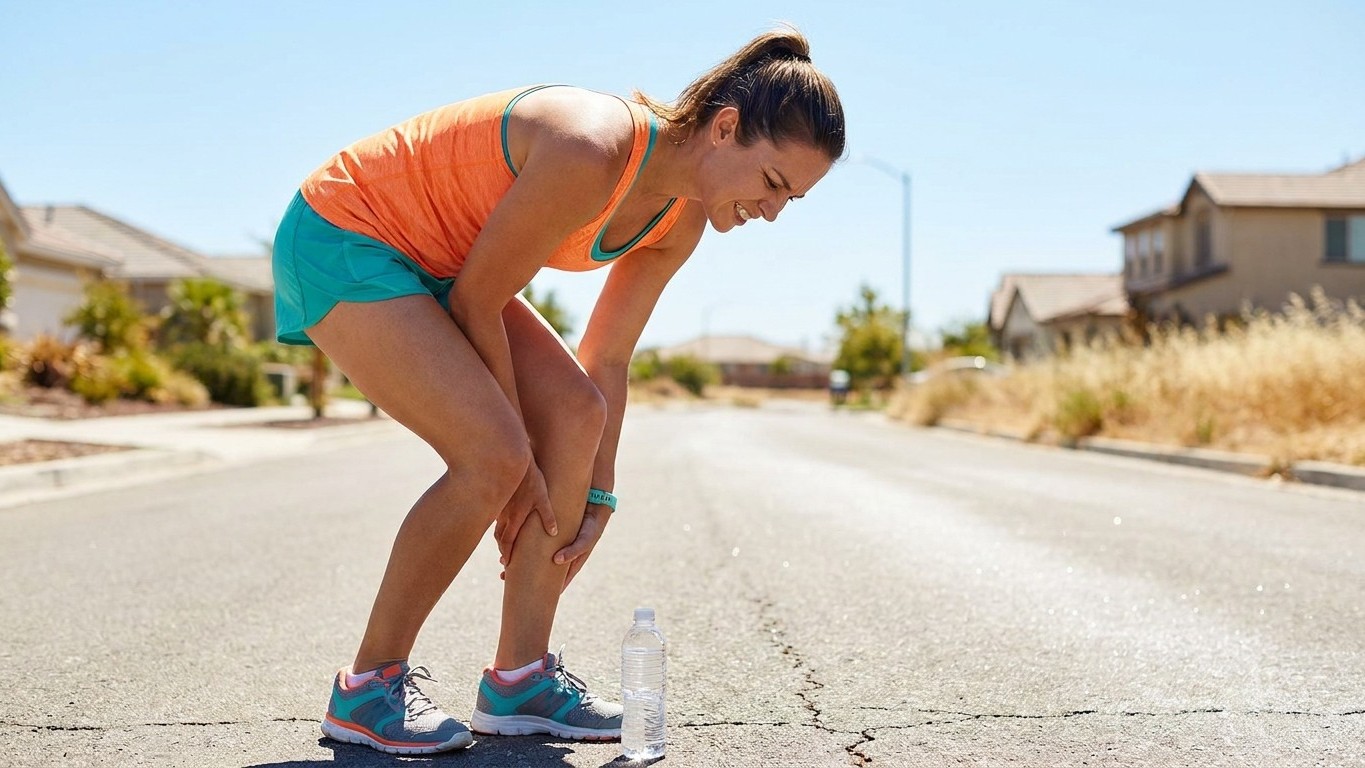
The calves lock up without warning. No buildup, no gentle hint, just a sudden, iron-tight clench that stops you mid-stride on a May morning when the pavement is already baking and you thought a gulp of ice water was exactly the right move. The instinct makes total sense. The physiology, though, tells a much more complicated story.
What happened during that run is actually a cascade of overlapping mechanisms, and the ice water was both a symptom of the problem and, in some ways, a contributor to it. Understanding the chain of events requires rethinking a few assumptions most runners carry around like extra weight in their hydration pack.
Key takeaways
- Plain ice water during exercise actively dilutes electrolytes your muscles desperately need, making cramps more likely, not less
- Cold liquid triggers internal vasoconstriction, reducing blood flow to exhausted calves exactly when they need oxygen most
- Modern sports medicine reveals the real villain: your nervous system loses the ability to regulate muscle contraction during fatigue
The real problem started long before you reached for the bottle
By the time you were overheating at the midpoint of a run in warm weather, your body had already been losing something far more precious than water. When you sweat a lot, your body loses salt and nutrients (electrolytes) in the sweat. Those electrolytes, primarily sodium, potassium, magnesium, and calcium, act as electrical conductors that enable your muscles to contract and relax in a coordinated fashion. The moment that balance tips, the muscles become erratic, hyperexcitable, and prone to seizing up without Permission.
Those in hotter climates or in warmer weather are more likely to get cramps during activity, as there is more fluid loss. A May run, especially in the South or the Southwest, already stacks the deck against you before you take a single step. The calves, specifically, are among the most vulnerable. Muscle cramps have affected 67% of triathletes during or after training or racing, and 18% to 70% of marathoners or endurance cyclists, most often in the plantar-flexor muscle group. The calf is precisely that group, the gastrocnemius and soleus muscles, working overtime with every stride.
Now, the ice water. The reflex to reach for the coldest possible drink when overheated is understandable. But the choice of plain, icy water over an electrolyte drink was the physiological equivalent of pouring more gasoline on a fire you were trying to put out. People who solely drink plain water before and after exercise could in fact be making themselves more prone to cramps, because pure water dilutes the electrolyte concentration in the body and doesn’t replace what is lost during sweating. The research from Edith Cowan University, published in the Journal of the International Society of Sports Nutrition, made this explicit: “muscles become more prone to cramp by drinking plain water, but more immune to muscle cramp by drinking the electrolyte water.”
So that large gulp of ice water, meant to rescue you, actively diluted whatever sodium and potassium were still circulating. The muscles didn’t cramp because you drank cold water. They cramped because your body chemistry was already destabilized, and flooding the system with plain water finished the job. The cold just added one more layer.
What ice-cold liquid actually does to a working muscle
Here’s the part that genuinely surprises most people: cold exposure, even internal cold exposure from drinking, can trigger vasoconstriction, a narrowing of blood vessels. When the thermoreceptors in your skin (and, by extension, internal tissues) identify cold temperatures, they signal vasoconstriction, which is a smooth muscle contraction in the arteries that control blood flow to the extremities. Your legs, your calves, are your extremities. Blood flow to already-fatigued muscles gets temporarily reduced right when those muscles need oxygen and metabolic waste clearance the most.
Immersion in cold water results in a decline in acetylcholine production, which in turn causes a decrease in neuronal transmission rate. A 10°C–13°C decrease in skin temperature can reduce nerve conduction velocity by 10%–33%. Internally ingested ice water won’t produce the same dramatic effect as a full cold-water immersion, but the nerve signaling disruption is real, and it arrives at the worst possible moment in a muscle that’s already firing erratically from electrolyte depletion and fatigue.
Prolonged exposure to excessively low temperatures can lead to discomfort, muscle tightness, or even vasoconstriction, potentially hindering optimal recovery. The 20-minute delay between the gulp and the cramp isn’t coincidence, it’s the lag time for these compounding mechanisms to fully express themselves: diluted electrolytes, reduced nerve conduction, vasoconstriction-impaired blood flow, and pre-existing neuromuscular fatigue all colliding at once.
It’s not just about water and salt, the nervous system is the real culprit
The older explanation for exercise cramps was simple: you sweat, you lose electrolytes, you cramp. Drink more, cramp less. But sports medicine has moved significantly beyond that. The available evidence indicates that exercise-associated muscle cramps are multifactorial in nature and stem from an imbalance between excitatory drive from muscle spindles and inhibitory drive from Golgi tendon organs to the alpha motor neurons rather than dehydration or electrolyte deficits alone. This imbalance is believed to stem from neuromuscular overload and fatigue.
In simpler terms: your nervous system loses the ability to regulate muscle contraction properly when the muscle is exhausted. The altered neuromuscular control theory suggests that muscle fatigue disrupts the normal functioning of peripheral muscle receptors, causing an increase in excitatory afferent activity within the muscle spindle and a decrease in inhibitory afferent activity within the Golgi tendon organ, both of which then lead to an increase in alpha motor neuron discharge to the muscle fibers, producing a localized muscle cramp. The calf, locked in a shortened, contracted position with every push-off during running, is particularly vulnerable to this feedback loop going haywire.
Of all theories known regarding causes of exercise-associated muscle cramps, a neurological origin is supported by the most robust body of literature. This explains why simply stretching the cramping muscle often provides rapid relief, passive stretching increases tension in the muscle, reactivating the Golgi tendon organ’s inhibitory signal and breaking the involuntary contraction cycle. It also explains why simply drinking water, cold or otherwise, won’t fix a cramp that’s already set in.
What to do differently before, during, and after a hot run
Prevention here is genuinely multilayered. Starting pre-run, the goal is to arrive well-stocked with electrolytes, not just fluid. When you exercise, especially in hot conditions or for extended periods, you lose minerals through sweat, creating an electrolyte imbalance that disrupts the normal electrical signals between your nerves and muscles. Eating a sodium-containing snack an hour before a warm-weather run, even a small pinch of sea salt in your water, can meaningfully shift your baseline.
During the run itself, the temperature of your hydration drink matters more than most people realize. During workouts, people should drink water or sports drinks to replace electrolytes at set intervals and not gauge the need for water by the thirst mechanism alone. Thirst, by the time it registers consciously in the heat, often means you’re already behind. And if you’re going to drink cold water on a hard run, make it cool rather than ice-cold, the cooling benefit is still there, but the vasoconstriction effect is substantially reduced.
If a cramp strikes mid-run, stop and apply passive stretch immediately. Passive stretching is the most common and effective therapy to relieve acute muscle cramping. It increases the tension in a muscle, thereby increasing the Golgi tendon organ’s inhibitory input to the alpha motor neuron. Pull your toes toward your shin to lengthen the calf, hold it firm, and don’t release until the muscle fully relaxes. An electrolyte drink, not plain water, is the appropriate follow-up. Heat cramps are painful muscle spasms that happen when your body gets too hot, and they are a mild form of heat illness and a sign of heat exhaustion. Treat them as a warning signal, not an inconvenience to push through.
One last thing worth knowing: a more recent theory suggests that exercise-associated muscle cramps are related to sustained neural activity that results from fatigue, and that 1 to 2 hours of activity usually precipitate them. A mid-run cramp on a 45-minute outing isn’t “normal fatigue.” It’s a signal that your pre-run nutrition, your pacing relative to the heat, or your overall conditioning for warm-weather running needs recalibrating, and that ice water bottle you’ve been reaching for might need a pinch of salt added to it before you leave the house.
Sources : frontiersin.org | pmc.ncbi.nlm.nih.gov