
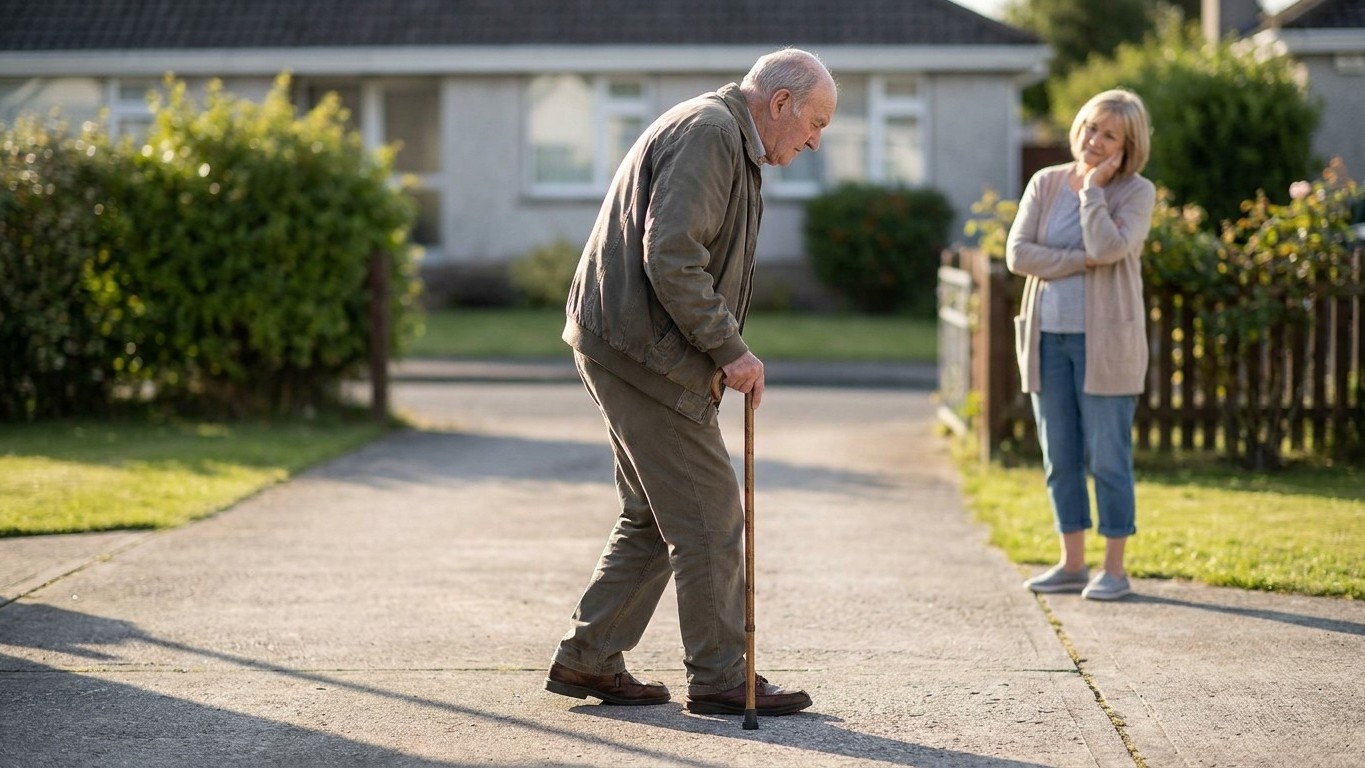
He didn’t stop walking. He just slowed down. A few shorter steps on the way to the mailbox, a slightly longer pause before getting up from his chair, a gait that had, almost imperceptibly, lost its forward momentum. His family noticed but filed it under the same folder labeled aging — the catch-all explanation we reach for when we don’t know what else to say. Then a neighbor, a retired nurse, watched him cross the driveway one afternoon and asked a single question: “Has he always walked like that, or is this recent?” That distinction changed Everything.
Key takeaways
- A neighbor’s simple question revealed that the father’s slowed gait wasn’t inevitable aging—it was a treatable condition
- Walking speed is medicine’s ‘sixth vital sign,’ ranked alongside blood pressure and heart rate, with profound implications for survival
- The rate of decline matters more than the speed itself: a rapid decline in gait speed predicts 90% higher mortality risk than gradual decline
Walking speed is a vital sign. Literally.
Here’s the thing most families don’t know: how fast an older adult walks is one of the most powerful health indicators in clinical medicine. Walking speed is a valid, reliable, and sensitive measure for assessing and monitoring functional status and overall health, and this is precisely why it has been designated the “sixth vital sign.” Temperature, blood pressure, pulse, respiratory rate, oxygen saturation — and then walking pace. Geriatricians have been measuring it in hallways for years. Most of us just haven’t been paying attention at family dinners.
Walking speed is an easily assessable and interpretable functional outcome, and since it was proposed as the sixth vital sign, research into its interpretation and use has flourished. The test itself is disarmingly low-tech. The gold standard is a space of 20 meters and a stopwatch, though research has shown that as little as 4 meters can be sufficient.
The numbers are telling. About a quarter of patients who come to seniors clinics fall into the low gait speed category, which is a speed of 0.2 to 0.6 meters per second. The “green zone” is above 1 meter per second. To put that in relatable terms: normal gait speed ranges from 1.2 to 1.4 meters per second, which is the speed needed to safely cross an intersection. If someone can no longer cross the street before the light changes, that is, medically speaking, a warning sign.
What slowing down can actually signal
The retired nurse’s question was shrewd precisely because it distinguished between baseline and change. A person who has always been slow is one story. A person who used to stride and now shuffles is a completely different clinical picture.
One important reason why age-related changes in gait merit serious attention is that they are associated with an increased mortality risk. Several prospective cohort studies have focused on the relationship between gait and survival, and that connection has been demonstrated convincingly. A landmark pooled analysis of nine cohort studies involving over 34,000 adults aged 65 and older painted a stark picture: across all nine studies, a slower gait speed was associated with reduced survival, specifically, for every 0.1 m/s increase in walking speed, there was a corresponding decrease in mortality risk.
The trajectory matters as much as the speed. Participants with a fast decline in gait speed had a 90% greater risk of mortality than those with a slow decline. That statistic deserves a pause. Not slower walkers versus faster walkers, but people who were declining quickly versus those who were declining gradually. The rate of change is the alarm bell.
Then there’s the cognitive angle, which is perhaps the most counterintuitive part of this story. Most people associate dementia with memory lapses, not with the way their father crosses the kitchen. But research reveals that a slower walking pace and cognitive decline may together predict dementia risk. Studies show that slow gait speed predicted transitioning from mild to severe cognitive impairment, with hazard ratios indicating more than double the risk in some cohorts. The brain and the body communicate through movement; when that dialogue starts to break down, the legs often speak first.
Acute onset of a gait disorder may indicate a cerebrovascular or other acute lesion in the nervous system, but also systemic diseases or adverse effects of medication, including polypharmacy with sedatives. That last point is worth underlining: medications, not disease, are a shockingly common culprit. A new sleep aid, an adjusted blood pressure prescription, a combination of drugs that interact, any of these can alter gait practically overnight. The family who attributes slowing to “just aging” may be missing a completely reversible cause.
The conditions hiding behind a slower stride
The prevalence of gait disorders increases from 10% in people aged 60–69 to more than 60% in community-dwelling subjects over 80. Among the most common neurological causes are polyneuropathy, parkinsonism, and frontal gait disorders due to subcortical vascular disease or dementia.
Parkinson’s disease deserves specific mention because its early gait changes are subtle enough to be dismissed. Parkinson’s disease affects walking, balance and coordination, leading to shuffling, smaller steps, slower pace and reduced arm swing. Movement and sensory changes cause bradykinesia, hypokinesia and trouble starting, stopping or linking movements. Watch for reduced arm swing on one side, or small hesitations before stepping through a doorway, both can be early signs that predate a formal diagnosis by years.
Beyond neurology, the mechanisms underlying low physical performance include joint diseases, exhaustion or fatigue, reduced muscle strength, sarcopenia and low levels of physical activity. Sarcopenia, the age-related loss of muscle mass, is a particularly underdiagnosed condition, especially in people who appear otherwise healthy. Elderly patients with a gait speed less than 1.0 m/s have a higher risk of frailty, disability, depression, and dementia. One number. Multiple systems simultaneously at risk.
And then there’s heart failure, which can manifest quietly as fatigue and reduced exercise tolerance before any breathlessness appears. In geriatric medicine, if a patient’s pain isn’t managed well or their health condition leads them to pause their exercise, it becomes even harder to regain physical functioning, and that, in turn, can cause conditions like high blood pressure and diabetes to spiral out of control.
What to do when you notice the change
The retired nurse’s question was not dramatic. She didn’t say “something is seriously wrong.” She asked a single, precise question that reframed the observation from anecdote to data. That is the first move: document the change, note when it started, compare it to what was normal six months or a year prior.
Then bring it to a doctor, and be specific. Don’t say “he seems tired.” Say: “He used to walk from the car to the store in two minutes; now it takes five, and he started this about three months ago.” A recommended evaluation of slow walking includes assessment of the cardiopulmonary, neurological, and musculoskeletal systems. A good geriatrician will likely already have a hallway test in mind.
Improving usual gait speed predicts a substantial reduction in mortality. Because gait speed is easily measured, clinically interpretable, and potentially modifiable, it may be a useful vital sign for older adults. That word “modifiable” carries real hope. Strength training has modest effects on increasing gait speed in older adults, and improving upon modifiable factors may shift a trajectory toward slower decline. Reducing knee pain and obesity may also slow the rate of gait speed decline.
What the neighbor understood intuitively, and what decades of research confirm, is that the body tells its story in motion. A slower walk at 72 is not inevitably “just age.” It can be a treatable cardiovascular condition, an early neurological signal, a medication side effect, or the beginning of sarcopenia that responds beautifully to resistance training. The question worth asking any time you notice a parent, a partner, or a friend has changed the way they move through a room: when did this start? Because that date might matter more than anyone in the family realized.
Sources : pubmed.ncbi.nlm.nih.gov | mdpi.com