
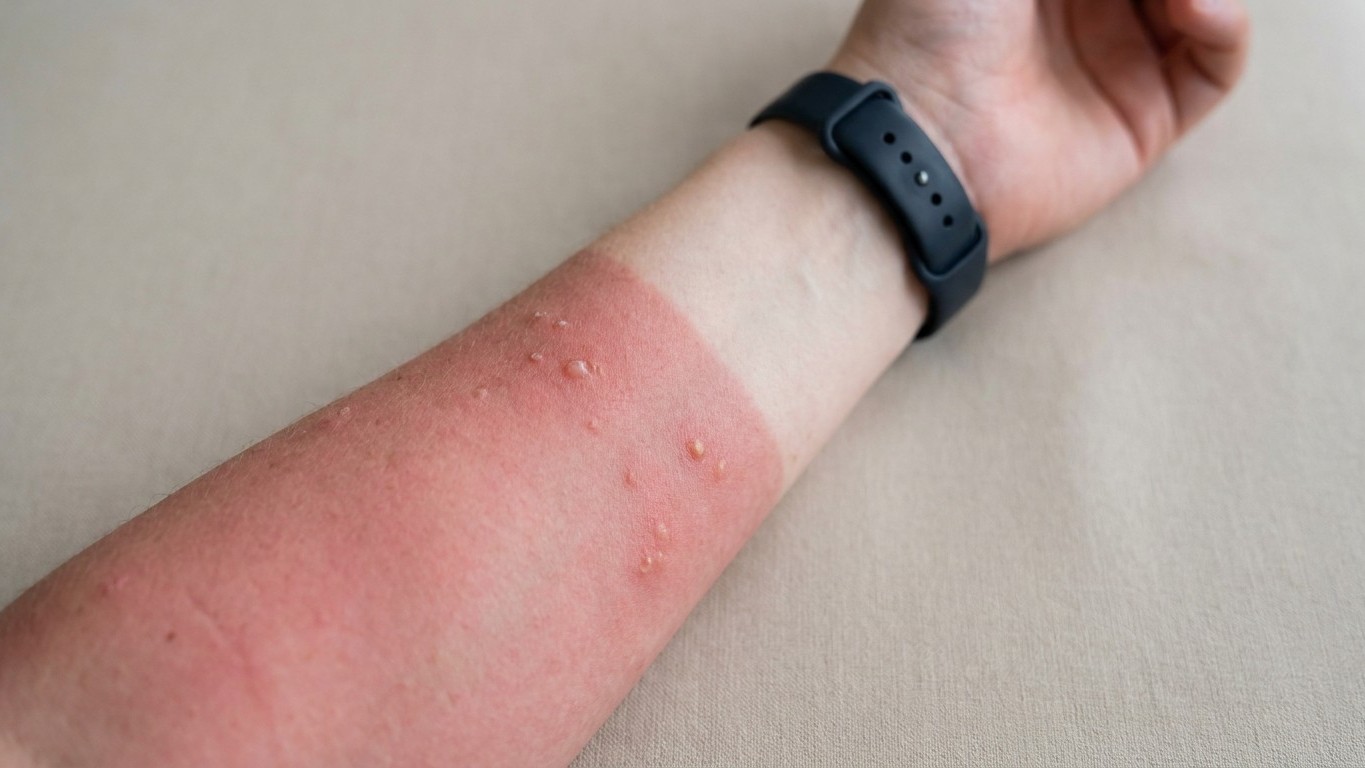
Last summer, a 20-minute walk back from the farmers market, no beach, no pool deck, no prolonged exposure to anything, left a patch of skin on the forearm angry, red, and blistered in a way that felt wildly disproportionate. The culprit wasn’t negligence. The sunscreen was applied. The real explanation was sitting in a weekly pill organizer, hiding in plain sight: a medication taken daily for years, never once connected to any sensitivity to sunlight.
This is more common than most people realize, and it’s happening to women at every age, across almost every category of routine medication.
Key takeaways
- 393 different medications can trigger photosensitivity—including common ones like ibuprofen and birth control pills you’ve probably never suspected
- The reaction can happen within 30 minutes of sun exposure and doesn’t require beach time—a parking lot or afternoon school pickup is enough
- Over 22% of prescriptions for people over 65 carry photosensitizing potential, but younger women taking routine medications are equally at risk
A side effect buried in the fine print
Drug-induced photosensitivity occurs when medications chemically alter skin cells, making them abnormally reactive to ultraviolet radiation from sunlight or artificial UV sources. The tricky part? It can be triggered by products applied to the skin or medicines taken by mouth or injected. So yes, that pill you’ve been swallowing every morning for three years could be quietly rewriting your skin’s relationship with the sun.
There are two types of photosensitivity: photoallergy, which is an allergic reaction of the skin and may not occur until several days after sun exposure, and phototoxicity, which is more common and can occur within a few hours of sun exposure. The phototoxic version is the one that trips people up most often, the combination of the drug and the ultraviolet light from the sun generates toxic and inflammatory reactions that are harmful for skin cells, causing a sunburn-like effect on skin when you go out in the sun. You don’t need to be lying on a beach towel. A parking lot, a patio lunch, an afternoon school pickup — that’s enough.
Here’s the counterintuitive part that dermatologists keep repeating: phototoxicity can occur with the first dose, but it also presents as a non-immunologically mediated response, meaning Your Immune System isn’t even necessarily involved. The reaction is chemical, not allergic. You’re not “developing a new allergy.” The drug and the UV rays are simply interacting in your skin, and your body is the battlefield.
The medications you’ve probably never suspected
393 different drugs and compounds can make skin dangerously sensitive to sunlight. That number is not a typo. For anyone over 65, over 22% of their prescriptions carry photosensitizing potential. But the list doesn’t spare younger women either.
Photosensitivity can be caused by medications including certain antibiotics such as Bactrim or ciprofloxacin, NSAIDs, tricyclic antidepressants such as amitriptyline, diuretics, and certain diabetes and high blood pressure medicines. Read that list again slowly. Antibiotics taken for a UTI. Ibuprofen grabbed for a migraine. A water pill prescribed for blood pressure. Both prescription and over-the-counter drugs can cause a reaction, including very common ones like ibuprofen and birth control pills.
The birth control connection is one that rarely gets flagged at the pharmacy. Some birth control medicines containing estrogen and progestin can make you more sensitive to sunlight. If you’re starting a new oral contraceptive, it’s worth waiting to expose yourself to the sun until you know how your skin will react on the new medication. But what about a pill you’ve been on for five years? The reaction can appear at any point, triggered by a change in sun intensity, a new skincare ingredient, or simply an accumulation your body finally can’t buffer.
Cholesterol-lowering drugs known as statins, including simvastatin, atorvastatin, lovastatin, and pravastatin, also cause photosensitivity. Statins are among the most prescribed medications in the country. Millions of women take them, often starting in their late 40s or 50s, and almost nobody mentions the UV sensitivity piece during the prescription conversation.
The skincare shelf is just as guilty. Common over-the-counter products including retinol, benzoyl peroxide, AHAs, and supplements like St. John’s Wort can significantly increase the skin’s sensitivity to UV radiation. A retinol serum at night, a glycolic acid toner in the morning, an SSRI before bed, the combination effect on sun sensitivity is almost never discussed, even though the individual ingredients each carry a warning.
What the reaction actually looks like
The confusion around drug-induced photosensitivity is partly visual. Symptoms can include an exaggerated sunburn reaction, skin irritation, pain, localized swelling, blisters, and redness. “Exaggerated sunburn” is the operative phrase here. This is not a pink flush from forgetting SPF. Patients with drug-induced photosensitivity often note intolerance to sunlight. Whereas most individuals can tolerate minutes or hours of sun exposure, those with drug-induced photosensitivity will exhibit skin lesions of one type or another, in most cases, a sunburn response or dermatitis.
The pattern is also telling. Diagnosis is based primarily on the history of drug intake and the clinical appearance of the eruption, which primarily affects sun-exposed areas of the skin. A watch tan line left unmarked. A collar-shaped burn that stops exactly at the neckline. Hands and forearms scorched while legs are fine. These geometric clues are the dermatologist’s first hint that something other than sun exposure is at play.
Photoexcitation and photoconversion of drugs trigger multidirectional Biological reactions, including oxidative stress, inflammation, and changes in melanin synthesis, effects that contribute to the appearance of erythema, swelling, blisters, exudation, peeling, burning, itching, and hyperpigmentation of the skin. That last one matters long-term. Drug-induced photosensitivity often resolves upon ceasing the causative medication, although post-inflammatory hyperpigmentation may persist in phototoxic reactions. The sunburn heals. The dark patch it leaves behind sometimes does not — at least not quickly.
What to actually do about it
The answer is not to stop taking your medication. Full stop. It’s important to understand the risks associated with anything you’re taking, but you should never skip or discontinue taking a medication prescribed by your doctor without first consulting them. What the answer is: have a different conversation with your prescriber and your pharmacist, one that most of us have never thought to initiate.
If you have had sun sensitivity in the past, ask your healthcare provider about medication alternatives. And if you haven’t had a reaction yet, that’s exactly the right time to ask, before you’re standing in an urgent care clinic trying to explain why a cloudy afternoon left you looking like you fell asleep on a reflective tarp.
Protection-wise, the approach needs to go further than a standard SPF 30. Some reactions are caused by exposure to the sun’s UVB or “short” waves, but most are caused by UVA or “long” wave exposure. That means a broad-spectrum sunscreen is non-negotiable, the kind that explicitly protects against both UVA and UVB. Avoiding outdoor activities between 10 a.m. and 4 p.m. sounds inconvenient until you consider that a phototoxic reaction on a medication like doxycycline or hydrochlorothiazide can blister in under 30 minutes of midday exposure.
One detail that almost never comes up in these conversations: both types of photosensitivity occur after exposure to ultraviolet light, either natural sunlight or artificial light, such as a tanning booth. Fluorescent office lighting and UV nail lamps are also worth knowing about. The sun doesn’t have a monopoly on triggering these reactions.
The most unsettling part of all this isn’t the burn itself. It’s the years, sometimes decades, people spend on a photosensitizing medication, faithfully applying SPF 15 on beach days and assuming they’ve covered their bases, while the real variable was sitting in a prescription bottle all along. Dermatologists increasingly see patients who had perfect sun habits and still ended up with unexplained hyperpigmentation, recurring “sunburns” in unusual spots, or skin damage that accumulates silently across sun-exposed areas over time. The medication conversation is long overdue, and it belongs in the exam room, not just the fine print.
Sources : pmc.ncbi.nlm.nih.gov | ncbi.nlm.nih.gov