
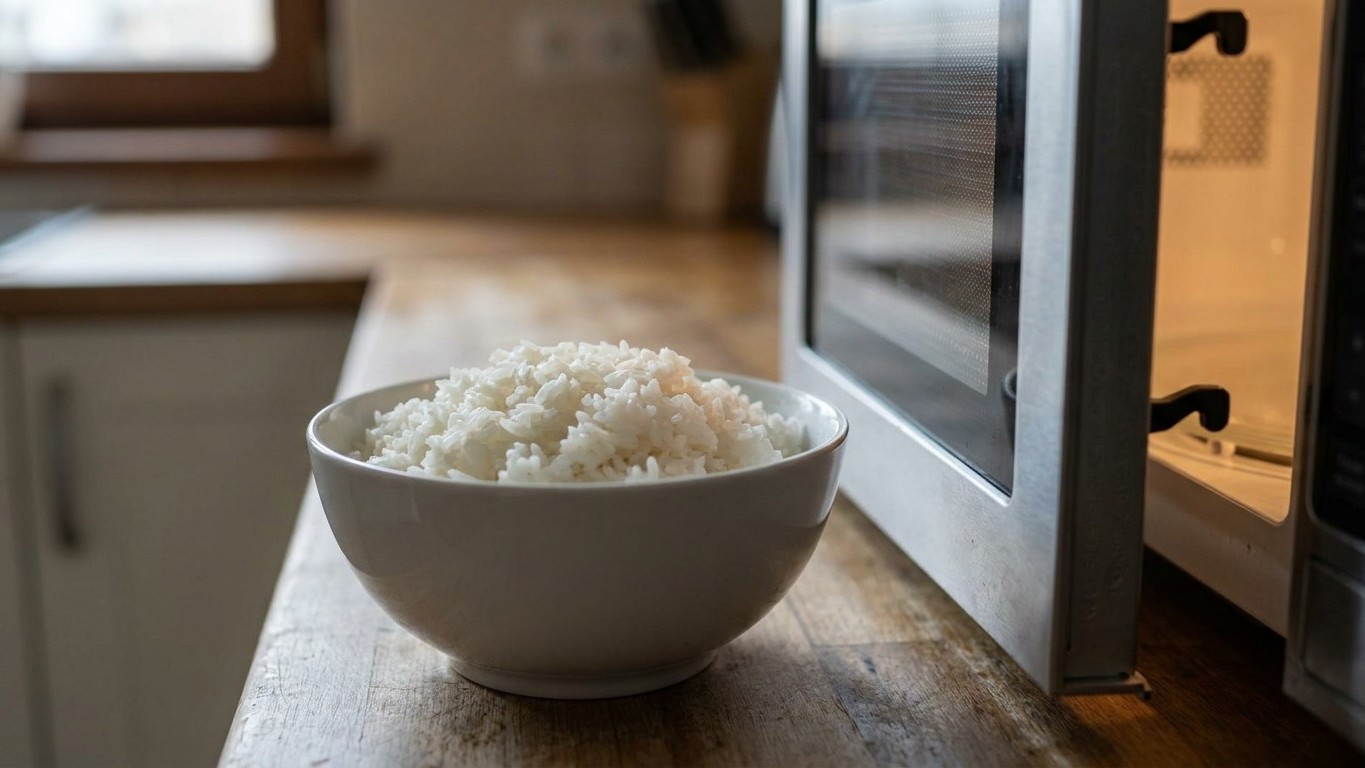
The rice looked perfectly fine. No smell, no slime, nothing suspicious. Just last night’s white rice, pulled from the fridge, blasted in the microwave for two minutes, eaten at noon. By 6 p.m., the chills started. By 8 p.m., it was a full sprint to the bathroom. The culprit wasn’t the chicken, wasn’t the sauce, wasn’t anything exotic. It was the rice.
This is what food safety experts call “reheated rice syndrome”, and the microwave, despite its reassuring hum and steam, did absolutely nothing to protect you.
Key takeaways
- Your microwave kills the bacteria but leaves behind invisible heat-stable toxins that cause severe illness 6-12 hours later
- Rice left at room temperature for just a few hours creates the perfect breeding ground for a dangerous bacterial toxin
- The safe window between cooking and refrigerating is shockingly short—and most people get it completely wrong
The Bacteria That Laughs at Your Microwave
Reheated rice syndrome is food poisoning caused by Bacillus cereus, a bacteria that spreads in improperly cooled starches. What makes it particularly sneaky is the mechanism: it survives the initial cooking process as a spore, and if left out at room temperature, it produces toxins. So even when you reheat the rice, you’re killing the vegetative cells, but you’re not destroying the toxins.
Think about that for a second. The microwave does its job. The bacteria are technically killed. But the toxins they already released into the rice? Those are a different story entirely. These toxins are heat stable and will survive getting zapped in the microwave or cooked in another dish. The damage, was done hours before you even touched the reheat button.
People call it “fried rice syndrome” because the process of cooking rice, leaving it out, and then reheating it creates a perfect environment for this germ. Rice is also a bunch of tiny pieces, so it has more surface area than something like a steak, and more surface area means more places for germs to hide. A steak on a plate is one solid surface. Rice is thousands of tiny warm, moist pieces, each one a potential landing pad.
What Actually Happens Inside Your Body
Symptoms from Bacillus cereus form within 6 to 12 hours, which is faster than most foodborne illnesses. Expect nausea, cramps, and a significant amount of vomiting. The bacteria can also cause severe diarrhea if it multiplies in your intestine and produces toxin. Both at the same time, in some cases. Hence the shaking over the toilet.
Most people can handle a small amount of these toxins, but if Bacillus cereus multiplies enough in the “danger zone” of between 40°F and 140°F, it can make you sick. That danger zone is precisely the range your rice sits in when you leave it on the counter to “cool down” before refrigerating, a habit that feels responsible but is actually the opposite.
The good news, if you can call it that mid-episode: symptoms of reheated rice syndrome typically resolve within 24 hours. Getting rest and drinking plenty of fluids can help. The bad news: severe vomiting or diarrhea can lead to dehydration, which can be life-threatening. Rarely, the infection can spread to other parts of your body, damaging your organs. Death from B. cereus is extremely rare, but not impossible, a Belgian case documented in the Journal of Clinical Microbiology involved a 20-year-old who died after eating pasta left out at room temperature for five days and then reheated.
The CDC estimates Bacillus cereus causes 63,000 annual cases of foodborne illness in the United States and only 20 hospitalizations, which puts the real risk in perspective. Serious, but not a pandemic. Unpleasant enough, though, that it’s absolutely worth preventing.
The Counter-Intuitive Truth About “Safe” Leftovers
Here’s where most people get it wrong: they assume that if rice went straight into the fridge after dinner, they’re safe. Not necessarily. Research published in the journal Foods (MDPI, 2023) found that Bacillus cereus spores can survive cooking and rapidly grow when rice is stored at warm temperatures (25–30°C). In contrast, refrigeration at 4°C effectively prevented bacterial growth for up to seven days. The temperature matters, but so does the window of time between cooking and refrigerating.
The UK’s Food Standards Agency suggests that it may be OK to eat rice leftovers within 24 hours if they cool down quickly and are then refrigerated, ideally within one hour. One hour. Not two, not “until it stops steaming,” not “after the kids are in bed.” One hour is the working target. Spread rice out in a shallow dish or tray to cool faster, and refrigerate it within one to two hours at most.
Also worth knowing: Bacillus cereus is also found on other starches like pasta and potatoes. Another spore-forming bacteria called Clostridium perfringens grows on gravy and meats and also produces toxins resistant to cooking and reheating. The rice gets all the attention, but last night’s pot roast sitting in its own juices can play the same dangerous game.
How to Actually Store Rice So This Never Happens Again
The fix is low-tech and takes about 90 seconds of planning after dinner. Since cooking and reheating can’t destroy the toxin, the only way to stay safe is to stop the bacteria from multiplying in the first place. Once you’re done cooking, don’t let rice sit out on the stove or counter, spread it out in a shallow dish or tray to cool faster, and refrigerate it within one to two hours at most.
If you make a big portion, break it up into smaller storage containers before refrigerating. Don’t put a hot, covered pot of rice in the fridge, that will trap heat and take a long time to cool. After storing rice in smaller containers, put it right in the fridge; you don’t need to wait for it to cool down first.
When it’s time to reheat, temperature matters too. You can reheat rice on the stovetop, in the microwave, or even in the oven, but be sure it reaches an internal temperature of 165°F. For added safety, stir the rice halfway through reheating to make sure it’s evenly heated. Microwaves are notorious for heating unevenly, leaving cold spots where surviving bacteria can linger.
Cooked rice can keep for up to three or four days in the refrigerator. If the rice smells sour, has a slimy texture, or you’re just not sure how long it’s been in the fridge, toss it out. It’s not worth the risk.
One last thing that most food safety guides quietly skip over: the “Keep Warm” setting on rice cookers is not a safe long-term storage solution. If you leave rice in a rice cooker on the “Keep Warm” setting, measure it with a thermometer to make sure it’s at least 150°F and out of the danger zone. Without that check, you may be holding your rice at exactly the temperature Bacillus cereus finds most hospitable, for hours at a time, meal after meal, completely unaware.
Sources : foodpoisoningnews.com | rightasrain.uwmedicine.org