
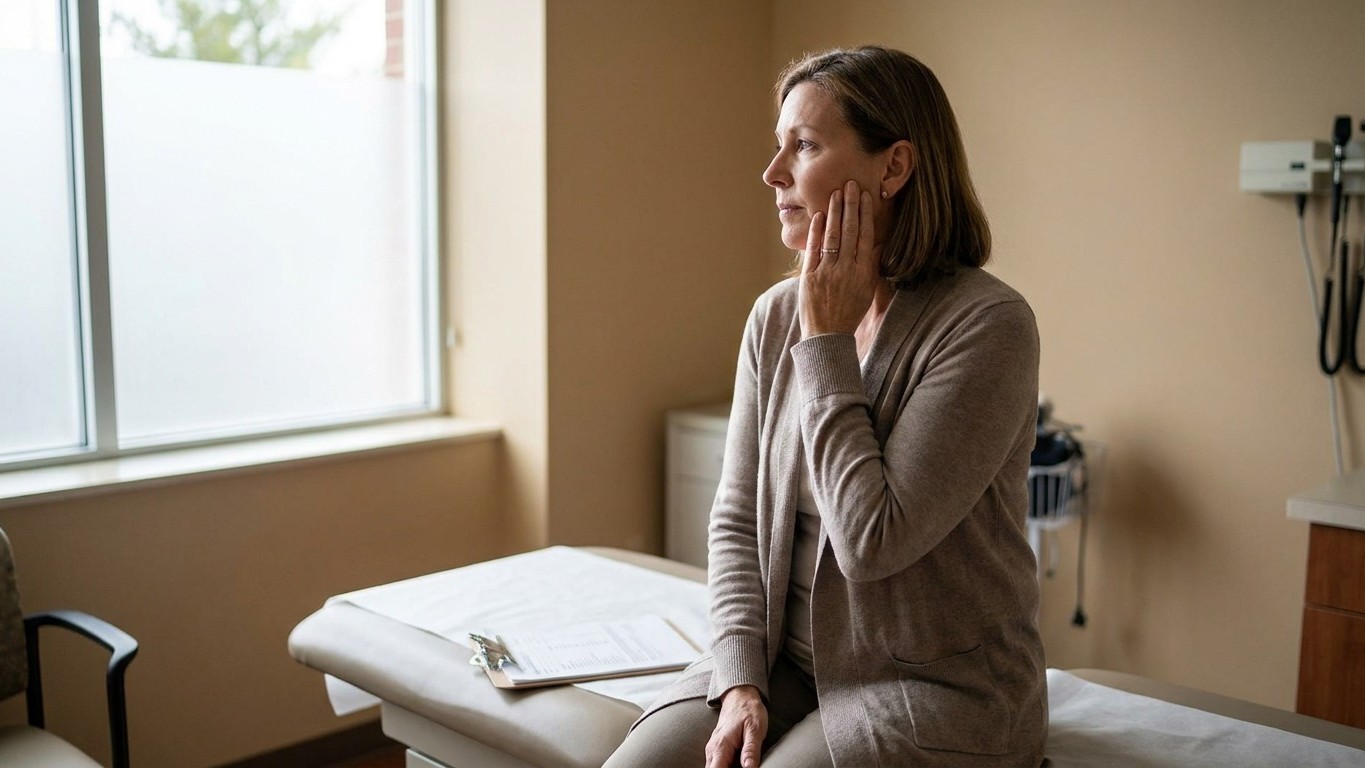
The cardiologist didn’t raise her voice. She just turned the monitor slightly, tapped a finger against a graph of coronary flow, and said the two arteries feeding the heart’s muscle weren’t the problem. The problem was smaller. Invisible on a standard angiogram. The kind of vessels most doctors never think to check until a woman has spent six weeks explaining away jaw pain and bone-deep exhaustion as “just menopause.”
That diagnosis has a name: coronary microvascular dysfunction, or CMD. It doesn’t show up as a blockage. It shows up as a heart quietly starving for blood through arteries too thin to see on the tests everyone assumes are thorough.
Key takeaways
- A cardiologist’s discovery reveals why a woman’s six-week delay in diagnosis nearly cost her everything
- Half of women with angina symptoms have no blockages—yet their hearts are genuinely failing in ways standard tests cannot see
- The timing trap: menopause causes the exact hormonal changes that trigger microvascular heart disease, while also providing the perfect cover story to ignore it
Why a woman’s heart complains differently
Cardiologists have known for years that heart disease doesn’t announce itself the same way in women as it does in men, yet the gap between knowing and acting on it remains wide. Microvascular angina due to CMD is more prevalent in women compared to men and is underdiagnosed and undertreated, often resulting in repetitive testing and impaired quality of life. Instead of the crushing chest pain seen in movies, the signals are quieter and easier to explain away.
At Johns Hopkins, cardiologist Erin Michos describes the pattern bluntly: women might feel extreme fatigue that rest doesn’t make better, pain with exertion in their back, jaw or arm with no chest pain, or nausea and indigestion. And this isn’t a rare subset. According to the American Heart Association, up to 50 percent of women with angina symptoms don’t have a blocked artery. Half. That statistic alone should reshape how emergency rooms triage chest discomfort in women, and yet it rarely does.
The research backing this goes back decades. In the landmark WISE study, forty-seven percent of women with chest pain and no obstructive coronary disease had subnormal coronary flow velocity reserve, suggestive of microvascular dysfunction. Nearly one in two. These weren’t anxious women imagining symptoms. Their arteries were genuinely failing to deliver enough blood, in a way no standard cath lab image would catch.
The menopause trap
Here’s where the story gets uncomfortable, because the very transition being blamed for the symptoms is also biologically linked to the disease causing them. Women get coronary microvascular disease more often than men, especially those with low estrogen levels, which commonly occurs during menopause. Estrogen protects vessel walls and helps regulate how they dilate. When it drops, small arteries lose some of that flexibility, right around the same years a woman is also managing hot flashes, sleep disruption, joint aches and mood swings that look remarkably similar to cardiac warning signs.
A physician quoted by The Educated Patient summed up the trap plainly: a lack of female-focused research means both doctors and women routinely dismiss critical cardiac symptoms, like jaw pain and fatigue, as simple stress, anxiety or exhaustion, while clinicians are statistically more likely to misdiagnose these events as anxiety or musculoskeletal issues. It’s not carelessness so much as a script nobody has bothered to rewrite. Chest pain reads as “heart.” Jaw ache and tiredness read as “midlife.” Nobody trains us to connect the two.
Timing makes the danger worse. Women wait an average of 54 hours to seek treatment compared with 16 hours for men. Six weeks of self-diagnosing hormonal fatigue isn’t an outlier behavior born of denial. It’s the statistically expected response for a woman raised to believe her body’s alarms are probably just biology doing its thing.
What six weeks actually costs
The numbers on delayed diagnosis are not abstract. A 2025 study found that of participants with missed angina, 63% were women compared with 37% of men. Once a heart problem is missed, the consequences compound. Women with delayed or missed myocardial infarction diagnoses face higher morbidity, including increased rates of heart failure, recurrent ischemia, and reduced long-term quality of life. Every week spent attributing jaw pain to grinding teeth or stress is a week the microcirculation keeps struggling under strain it was never built to sustain alone.
Younger women fare no better at the intake desk. Research published in the Journal of the American Heart Association found that women under 55 were seven times more likely than men to be sent home from the emergency room without proper cardiac testing. Seven times. That figure deserves to sit uncomfortably, because it isn’t about symptoms being ambiguous. It’s about whose pain gets investigated on the first visit and whose gets a prescription for rest.
The moment the small arteries finally got looked at
What changes Everything is a test most primary care visits never order: an invasive or imaging-based assessment of coronary flow reserve, the kind that measures how well the tiniest vessels respond to demand rather than just checking for a blockage. Historically, standard angiograms failed to detect coronary microvascular dysfunction, frequently resulting in women with real ischemic pain being dismissed as healthy, but specialized invasive techniques can now measure coronary flow reserve and microvascular abnormalities in women who present with chest pain but “clean” major arteries. That’s the test that finally puts a name to six weeks of jaw ache and fatigue instead of a shrug.
It also opens the door to treatment, because CMD isn’t a dead end once it’s identified. Medications that improve microvascular tone, lifestyle changes targeting blood pressure and blood sugar, and closer monitoring during the menopause transition can all meaningfully reduce risk. The catch is that none of it starts until someone asks the right question, which usually means asking for a cardiologist who specializes in women’s heart health rather than accepting the first explanation offered.
One detail worth carrying out of any conversation about this condition: roughly 30 percent of women having heart attacks experience no chest pain at all. No pressure, no tightness, nothing that matches the poster in the waiting room. Just a jaw that won’t stop aching and a tiredness that sleep never fixes, quietly outlasting the six weeks someone gave it before finally asking why.
Sources : pubmed.ncbi.nlm.nih.gov | theeducatedpatient.com