
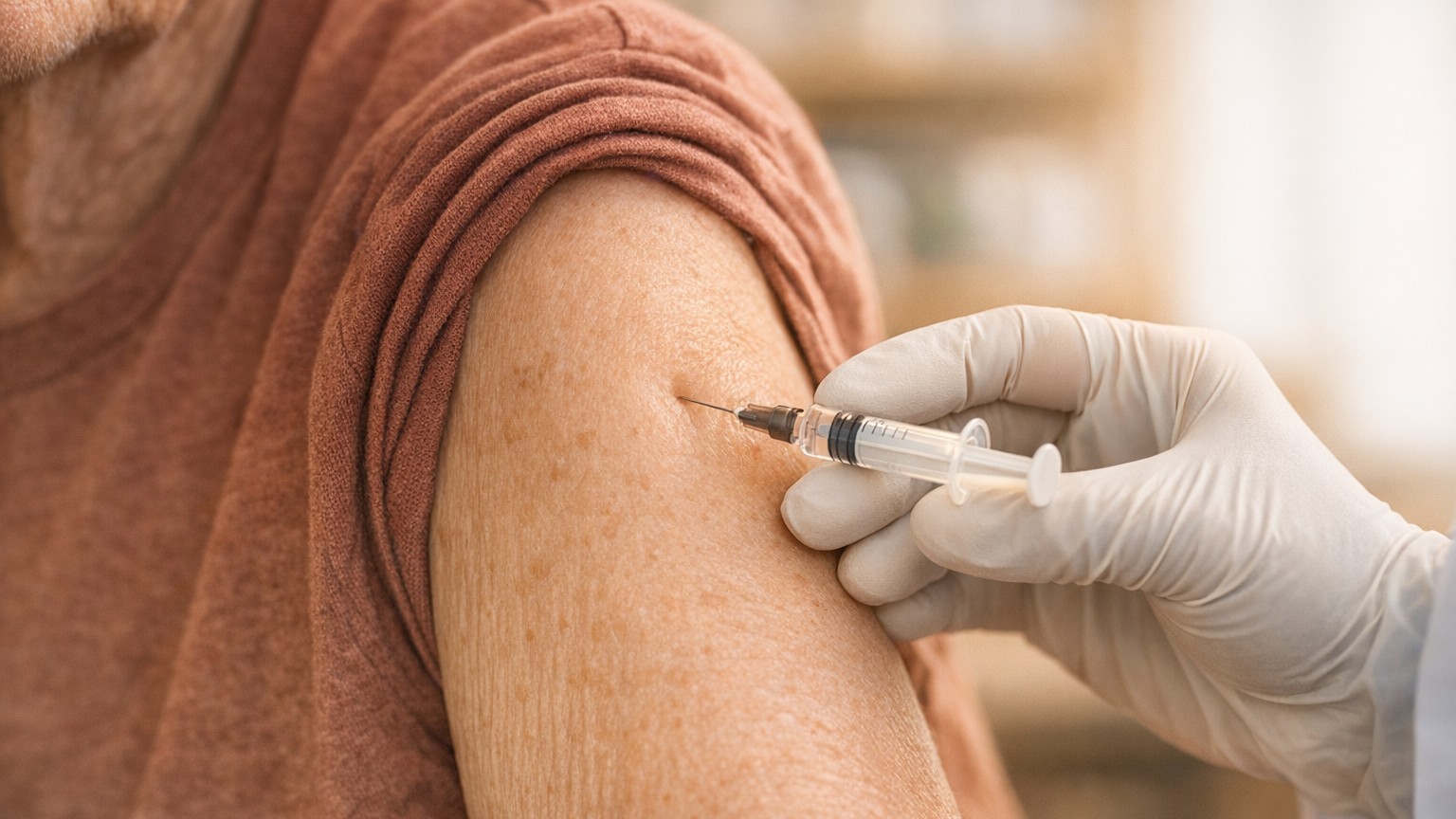
Every fall, the same ritual: a pharmacy line, a small sting in the arm, and the assumption that you’ve just done your duty against this year’s flu strain. Practical. Forgettable. Definitely not something you’d connect to the long-term fate of your brain. And yet, a growing and genuinely striking body of research suggests that the annual flu shot may be one of the most accessible tools we have for reducing the risk of Alzheimer’s disease, with numbers that would look impressive in any clinical trial for a dedicated neurological drug.
Key takeaways
- High-dose flu vaccines reduced Alzheimer’s risk by 55% in a major study of 165,000 older adults
- Influenza infections trigger brain inflammation linked to five neurodegenerative diseases including dementia
- Annual flu vaccination appears to provide cumulative brain protection—the more years you vaccinate, the stronger the effect
The numbers that stopped researchers in their tracks
In a claims-based cohort study of 935,887 propensity-score-matched pairs aged 65 and over, prior influenza vaccination was associated with a 40% relative risk reduction for incident Alzheimer’s disease over approximately four years. That alone was enough to make neurologists pay attention. But the most recent findings go further.
In a retrospective cohort study, researchers at McGovern Medical School at UTHealth Houston analyzed health data from roughly 165,000 older adults who received either a high-dose or standard-dose influenza vaccine, and found that the high-dose formulation reduced the risk of Alzheimer’s disease in those 65 and older by nearly 55% over a roughly two-year period. The study was published in Neurology in April 2026. Fifty-five percent. For a shot that most people treat as a seasonal chore.
The dose distinction matters here. The high-dose influenza vaccine contains four times the antigen of standard-dose vaccines, and the CDC already recommends it for all adults 65 and older. The immune system naturally weakens with age, making older adults less responsive to standard vaccines, which is the original reason the stronger formulation exists. The brain benefits appear to scale with that enhanced immune response.
The protective effect was more pronounced in women, a pattern that mirrors findings from shingles vaccine research and hints at sex-specific immune pathways that researchers are still unraveling.
What the flu actually does to your brain, and why that changes everything
Here’s the counterintuitive part. Most of us think of influenza as a respiratory inconvenience, a few brutal days on the couch. The idea that it could leave lasting marks on the brain feels far-fetched. But the biology is real, and it’s been accumulating in the literature for years.
Influenza and pneumonia, a potential complication of flu, are associated with five neurodegenerative diseases, including dementia and Parkinson’s disease, according to a 2023 study analyzing biobank data from over 400,000 people. The mechanism runs through inflammation. Vaccines prevent infections, and infections cause inflammation that can damage the brain. That inflammation can damage the ability of brain cells to communicate with each other, which in turn can lead to cognitive impairment and memory loss, contributing to dementia.
Influenza vaccination has been shown to increase microglia activity leading to clearance of amyloid-beta, and may decrease neuroinflammation, promoting a decrease in the incidence of dementia. Amyloid-beta, for context, is the protein that accumulates into plaques in Alzheimer’s disease. The fact that a flu vaccine could help clear it is not a small finding. It suggests the immune system, when properly primed, may be doing maintenance work in the brain that we barely understood a decade ago.
Possible non-antimicrobial mechanisms include induction of trained immunity, modulation of homeostatic imbalances associated with aging, including inflammaging and immunosenescence, and modification of the neuroinflammatory response to Alzheimer’s pathologies, leading to clearance and decreased injury to adjacent healthy brain tissue. Trained immunity, in plain terms, means the immune system becomes smarter and more responsive over time with repeated vaccination, not just against flu, but in a broader, systemic way.
The gap between what we know and what we do
Given all of this, you’d expect flu vaccination rates in the U.S. to be high. They are not. In 2023-2024, only about 45% of U.S. adults over the age of 18 were vaccinated against influenza. These metrics fall significantly short of the Healthy People 2030 goal of 70% coverage nationally.
The irony runs deeper when you consider who’s most at risk. Alzheimer’s disease affects more than 7 million Americans age 65 and older as of 2025, representing about 1 in 9 people in that age group, with the number projected to more than double by 2050. And yet, prevention through influenza vaccination is not fully realized in older adults due to low levels of perceived risk, vaccine confidence, and variations in clinical practice guidance.
There’s also a feedback loop that’s almost cruel in its logic. Dementia itself is linked to lower vaccination rates, older adults with dementia are 22% less likely to receive flu vaccines than those without that diagnosis. The people who might benefit most from prevention are the least likely to receive it once cognitive decline has already begun.
What this means practically, right now
Researchers are careful to note the limits of what the current evidence can claim. This was a retrospective, claims-based target-trial emulation rather than a randomized trial, so the results should be interpreted as associative rather than definitively causal. No one is saying the flu shot is a proven Alzheimer’s cure. The science isn’t there yet.
But the direction of the evidence is consistent, large-scale, and biologically plausible. A 2023 meta-analysis of observational cohort studies with approximately 2.1 million participants and 4–13 years of follow-up found 31% less risk for dementia with influenza vaccination. A 2024 prospective UK Biobank analysis observed reduced risk of all-cause dementia and vascular dementia, with a dose-response across cumulative vaccinations, meaning the more consistently you vaccinate over the years, the stronger the association becomes.
That last detail is worth sitting with. The benefit isn’t just in getting a shot once, it appears to compound with annual repetition. Which reframes the whole exercise. The flu vaccine was never just about the flu. It may have been quietly doing neurological work all along, and we’re only now starting to measure it properly.
Future research should investigate whether the association is driven by reduced influenza burden or broader immunologic mechanisms, including trained immunity and reduced neuroinflammation, a distinction that could eventually reshape how we think about vaccination schedules for aging adults entirely.
Sources : uth.edu | neurologylive.com